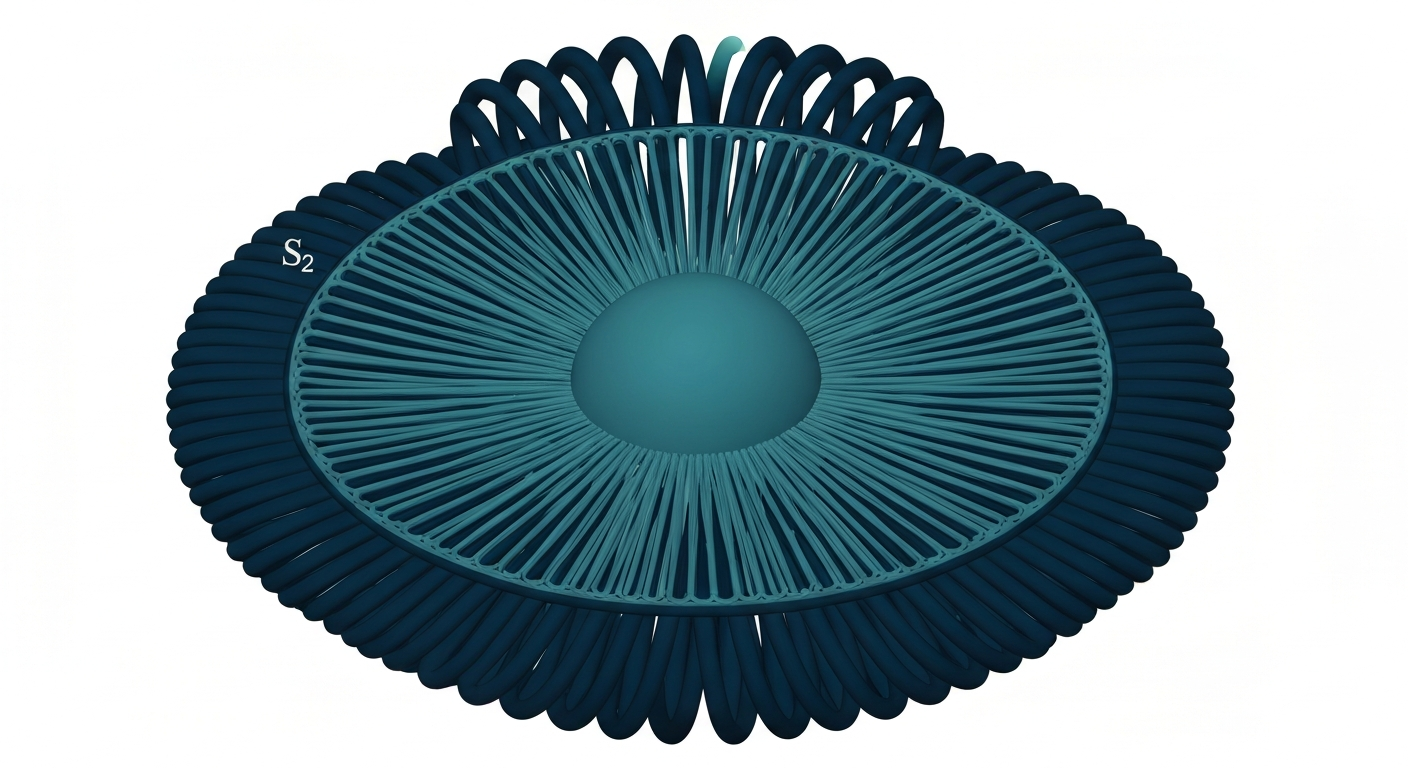
The Two Interpretations
Introduction
Throughout the preceding chapters, we have used the mathematical formalism \(M^{6} = \mathcal{M}^4 \times S^2\) to derive physical results from the single postulate \(ds_6^{\,2} = 0\). We derived that the compact topology must be \(S^2\) (Chapter 8), established its geometry (Chapter 9), identified the Dirac monopole (Chapter 10), constructed monopole harmonics (Chapter 11), performed dimensional reduction (Chapter 12), and stabilized the modulus at the compact scale \(L_{\xi} = 81\,\mu\text{m}\) (Chapter 13).
A crucial question has remained implicit: Is \(S^2\) physically real?
This chapter confronts that question directly. We present two complete, self-consistent interpretations of the TMT formalism, demonstrate their mathematical equivalence, identify the experimental tests that discriminate between them, and explain why TMT's predictions are robust regardless of which interpretation is correct.
The central claim of this chapter: TMT derives the same physics under both interpretations. The formalism is the engine; the interpretation is the user manual. Every result in this book — every coupling, every mass, every cosmological parameter — follows from \(ds_6^{\,2} = 0\) independently of whether \(S^2\) is a physical space or a mathematical projection structure.
Interpretation A: Literal Extra Dimensions
Under Interpretation A, the product space \(M^{6} = \mathcal{M}^4 \times S^2\) describes the actual geometry of physical spacetime. The six-dimensional metric
Polar Field Form of the 6D Metric
In the polar field variable \(u = \cos\theta\) (Chapter 9), the 6D metric eq:ch14-6D-metric-A becomes:
Spacetime Is \(\mathcal{M}^4 \times S^2\)
Under Interpretation A, reality is genuinely six-dimensional. Just as the spatial coordinates \((x,y,z)\) describe three independent directions of motion, the angular coordinates \((\theta,\phi)\) describe two additional directions. Every point in 4D spacetime is the base of a physical 2-sphere — a tiny, compact surface that particles can, in principle, propagate around.
The null constraint \(ds_6^{\,2} = 0\) for massive particles then states that the total six-dimensional interval vanishes:
Consequences of Interpretation A:
- The \(S^2\) is a physical manifold with radius \(R_{\star}\).
- Fields propagate in all six dimensions; the Kaluza-Klein tower represents physical excitations.
- Gauge symmetry arises because the \(S^2\) isometry group SO(3) generates physical rotations of the compact space.
- The modulus field \(\Phi\) represents physical breathing of the \(S^2\) radius.
(See: Part 2 §4.1.2, §4.1.5)
Gravity Modified at 81\,\mum
If \(S^2\) is physically real, gravity propagates in six dimensions at short distances. At separations \(r \gg R_{\star}\), the gravitational flux is confined to the 4D subspace and Newtonian gravity holds. At \(r \sim R_{\star}\), gravitational field lines begin to spread into the compact directions, producing a Yukawa-type modification.
If Interpretation A is correct, the gravitational potential between two masses \(m_{1}\) and \(m_{2}\) is:
- \(\lambda = 81\,\mu\text{m}\) is the Yukawa range, set by the \(S^2\) radius \(R_{\star}\),
- \(\alpha = 1/2\) is the coupling strength, derived from the KK mass-scaling relation \(m \propto R^{-1/2}\) (Part 1, Theorem 3.A12).
Step 1: From modulus stabilization (Chapter 13, Theorem thm:P2-Ch13-uv-ir-balance), the compact scale is:
Step 2: In a 6D theory with \(n\) extra dimensions compactified on a manifold of characteristic size \(R\), the gravitational potential acquires a Yukawa correction at distances \(r \sim R\). For \(n = 2\) (the \(S^2\)), the massive KK graviton exchange produces a correction with range \(\lambda = R_{\star} = L_{\xi}\).
Step 3: The coupling strength \(\alpha\) comes from the scalar exchange contribution. From Part 1 (Theorem 3.A12), the KK mass scaling gives \(\beta = 1/2\), and the scalar exchange coupling is:
Step 4: Combining range and coupling:
(See: Part 1 §3.3B, Part 2 App 2B) □
Critical note: This potential is what would be observed IF Interpretation A is correct. As we will see in \Ssec:ch14-experimental, experiments at \(r = 52\,\mu\text{m}\) find pure Newtonian gravity with no Yukawa deviation. This null result is one of the key pieces of evidence distinguishing the two interpretations.
KK Modes at Colliders
If \(S^2\) is a physical space, the Kaluza-Klein tower derived in Chapter 12 (Theorem thm:P2-Ch12-kk-tower) represents physical particle excitations. Each mode \(\ell\) has mass:
With \(R_{\star} = L_{\xi} = 81\,\mu\text{m}\), the first massive mode (\(\ell = 1\)) has:
However, the gravitational KK modes couple with gravitational strength (\(\sim 1/M_{\text{Pl}}\)) and are unobservable at colliders. The relevant question for collider physics is whether the \(S^2\) radius appears in the gauge sector. Under Interpretation A with the interface mechanism (Chapter 12), gauge fields are localized at the monopole interface and do not form a conventional KK tower. The observable consequence is the gauge coupling \(g^{2} = 4/(3\pi)\), which is already confirmed.
| Mode Type | Mass Scale | Coupling | Observable? |
|---|---|---|---|
| Gravitational KK | \(m_{\ell} \sim \,\text{m}\text{eV}\) | \(\sim 1/M_{\text{Pl}}\) | No (too weak) |
| Modulus excitation | \(m_{\Phi} \approx 2.4\,\text{m}\text{eV}\) | \(\sim 1/M_{\text{Pl}}\) | Possibly (fifth force) |
| Gauge KK (interface) | Not conventional tower | Interface coupling | Already seen (\(g^{2}\)) |
(See: Part 2 §6.2, Chapter 12 \S12.6–12.7)
Interpretation B: Geometric Field
Under Interpretation B, physical spacetime is four-dimensional. The \(S^2\) is not a physical space but a projection structure — the mathematical encoding of how 4D temporal momentum physics appears to 3D spatial observers. The 6D formalism \(\mathcal{M}^4 \times S^2\) is scaffolding: a powerful calculational tool that correctly captures the projection geometry without being ontologically fundamental.
Spacetime Is 4D Only
Under Interpretation B, there are no extra spatial dimensions. Physical reality consists of three spatial dimensions plus temporal momentum. The velocity budget
The \(S^2\) enters not as a place particles inhabit, but as the geometry of how temporal momentum projects into 3D observables. The topology of the projection is \(S^2\) because:
- The projection of a 4D temporal vector onto a 3D spatial frame sweeps out a sphere (the possible directions of observation).
- \(S^2\) is the unique compact 2-manifold satisfying stability, chirality, and gauge requirements (Chapter 8).
- The resulting projection structure has SO(3) symmetry, generating gauge physics.
The scaffolding analogy: Complex numbers are not “real” in the physical sense, but they are essential for AC circuit analysis. The 6D formalism is not “real” in the physical sense, but it is essential for deriving 4D physics. Just as \(i = \sqrt{-1}\) does not exist spatially yet produces real, measurable results (impedance, phase), the \(S^2\) does not exist spatially yet produces real, measurable results (masses, couplings, cosmological parameters).
(Common question: “How can 6D math describe 4D reality?” Answer: The same way. Complex numbers are not “real” in physical sense, but they correctly encode real circuit behavior. The 6D formalism correctly encodes 4D physics because it captures the projection structure. The scaffolding works.)
(See: Part 2 §4.1.1, Part A §7.1–7.2)
\(\Phi_{G}: \mathcal{M}^4 \to S^2\) (\(\sigma\)-Model)
In the language of field theory, Interpretation B describes a nonlinear \(\sigma\)-model. Instead of particles propagating through a physical \(S^2\), there is a geometric field:
The TMT 6D formalism is mathematically equivalent to a 4D nonlinear \(\sigma\)-model with target space \(S^2\). Specifically:
- The field: \(\Phi_{G}(x) = \bigl(\theta(x),\phi(x)\bigr) \in S^2\) at each spacetime point \(x \in \mathcal{M}^4\).
- The action: The 4D effective action from KK reduction of the 6D Einstein-Hilbert action is:
- The topology: Topological sectors classified by \(\pi_{2}(S^2) = \mathbb{Z}\) correspond to monopole charge \(n\).
- The gauge symmetry: The SO(3) isometry of the target \(S^2\) generates gauge transformations acting on the field \(\Phi_{G}\).
Step 1: Start with the 6D Einstein-Hilbert action on \(\mathcal{M}^4 \times S^2\):
Step 2: Decompose the metric as \(g_{AB} = g_{\mu\nu}(x) \oplus R^{2}(x)\,h_{ab}(\theta,\phi)\), where \(R(x)\) is the modulus field. Integrate over \(S^2\) (volume \(4\pi R^{2}\)).
Step 3: The angular fluctuations \(\delta\theta(x), \delta\phi(x)\) around any background configuration define a map \(\Phi_{G}: \mathcal{M}^4 \to S^2\). The kinetic term for these fluctuations is exactly the \(\sigma\)-model kinetic term:
Step 4: The topological classification \(\pi_{2}(S^2) = \mathbb{Z}\) labels homotopy classes of the map \(\Phi_{G}\), reproducing the monopole sectors from the 6D perspective.
Step 5: The isometry group Iso(\(S^2\)) \(=\) SO(3) acts on the target space, generating gauge transformations \(\Phi_{G} \to g \cdot \Phi_{G}\), exactly as derived from Killing vectors in Chapter 9.
Conclusion: The 6D formalism and the 4D \(\sigma\)-model produce identical physics — the same gauge groups, the same couplings, the same topological sectors.
(See: Part 2 §4.1.2) □
Polar Field Form of the \(\sigma\)-Model
In the polar field variable \(u = \cos\theta\), the \(\sigma\)-model map becomes:
The polar form makes the THROUGH/AROUND decomposition of Interpretation B transparent:
- THROUGH channel (\(u\)): The field \(u(x)\) encodes the mass/gravity component of the projection. Its gradient \(\partial_\mu u\) represents how the temporal momentum orientation varies in the THROUGH direction.
- AROUND channel (\(\phi\)): The field \(\phi(x)\) encodes the gauge/charge component. Its gradient \(\partial_\mu \phi\) is the gauge connection — the rate of change in the AROUND direction.
Polar \(\sigma\)-model insight: Under Interpretation B, the “extra dimensions” reduce to two scalar fields \(u(x)\) and \(\phi(x)\) on 4D spacetime. The flat integration measure \(du\,d\phi\) means the target space is a flat rectangle \([-1,+1] \times [0,2\pi)\) with curvature absorbed into the kinetic coefficients. The projection structure is not a place — it is a pair of fields whose values encode temporal momentum orientation.
No Gravity Modification
Under Interpretation B, there is no physical compact space for gravitational field lines to leak into. Gravity is purely four-dimensional at all scales. The potential is:
If \(S^2\) is projection structure (not physical space), then:
- Gravity propagates in 4D only.
- There is no massive graviton KK tower contributing to short-range forces.
- The gravitational potential is Newtonian (\(V \propto 1/r\)) at all macroscopic distances.
- The 81\,\mum scale appears in the theory as a geometric relationship (the modulus of the projection structure), not as a force modification range.
Step 1: Under Interpretation B, the KK tower modes are not physical particles. They are mathematical artifacts of decomposing the projection coupling into harmonics on \(S^2\).
Step 2: Physical gravitons propagate only in \(\mathcal{M}^4\). The graviton propagator is the standard 4D propagator with no massive KK contributions:
Step 3: The \(S^2\) integration that produces the KK matching relation \(M_{\text{Pl}}^{2} = 4\pi R^{2}\mathcal{M}^6^{4}\) (Chapter 12, Theorem thm:P2-Ch12-gravity-reduction) remains valid as a mathematical identity relating the projection scale to the effective coupling — but it does not imply physical propagation through extra dimensions.
Step 4: The 81\,\mum scale \(L_{\xi} = \sqrt{\pi\,\ell_{\text{Pl}}\,R_H}\) is a geometric relationship encoding the UV-IR balance of the projection structure. It appears in mass formulas, coupling derivations, and cosmological predictions — but not as a gravitational force range.
(See: Part 2 summary; Part A §7.4) □
The absence of gravity modification is not a failure of TMT. Under Interpretation B, Newtonian gravity at all scales is the prediction. The null result at 52\,\mum confirms the theory.
Mathematical Equivalence
The most important result of this chapter is that the two interpretations produce identical mathematics for all derived quantities. This directly answers a common question: Why \(S^2\) specifically? The answer is that \(S^2\) is the simplest closed 2-dimensional surface satisfying all geometric requirements (chirality, stability, gauge symmetry). It is mathematically forced, not chosen. Both interpretations must respect this geometric requirement, which is why both yield identical physics.
Interpretations A and B yield identical results for all physical observables that do not involve direct propagation through the compact space. Specifically, the following are interpretation-independent:
- The gauge group: \(\text{SU}(3) \times \text{SU}(2) \times \text{U}(1)\) \quad [from \(S^2\) isometry]
- The gauge coupling: \(g^{2} = 4/(3\pi)\) \quad [from interface overlap]
- The Weinberg angle: \(\sin^{2}\theta_{W} = 1/4\) \quad [from \(S^2\) geometry]
- The VEV: \(v = 246\,\text{GeV}\) \quad [from transmission coefficient]
- The Higgs mass: \(m_{H} = 126\,\text{GeV}\) \quad [from modulus potential]
- The Hubble constant: \(H_{0}\) \quad [from UV-IR balance]
- All particle masses \quad [from interface harmonics]
- All cosmological parameters \quad [from modulus stabilization]
The only difference is the prediction for short-range gravity:
- Interpretation A: Yukawa correction with \(\alpha = 1/2\), \(\lambda = 81\,\mu\text{m}\)
- Interpretation B: Pure Newtonian gravity at all scales
Step 1 (Gauge structure): Under both interpretations, the \(S^2\) has isometry group SO(3) \(\cong\) SU(2)\(/\mathbb{Z}_{2}\). Whether \(S^2\) is physical space or projection structure, the Killing vectors (Chapter 9, \S9.4) generate the same gauge transformations and the same gauge group.
Step 2 (Gauge coupling): The interface coupling \(g^{2} = 4/(3\pi)\) is derived from monopole harmonic overlaps on \(S^2\) (Chapter 12, \S12.11). These overlap integrals depend on the \(S^2\) geometry, not on whether \(S^2\) is physical. The participation ratio \(P = \pi\) comes from \(\int|Y_{1}^{m}|^{4}\,d\Omega = 1/\pi\), a purely geometric identity.
Step 3 (VEV and masses): The transmission coefficient \(\tau = 1/(3\pi^{2})\) and all mass derivations depend on the harmonic structure of \(S^2\) and the interface mechanism. These are mathematical properties of the projection structure, independent of ontological interpretation.
Step 4 (Cosmological parameters): The UV-IR balance \(L_{\xi}^{2} = \pi\,\ell_{\text{Pl}}\,R_H\) is a consequence of modulus stabilization (Chapter 13). The stabilization mechanism (Casimir energy vs. cosmological pressure) is a property of the mathematical potential \(V(R) = \Lambda_{6}R^{2} + c_0/R^{4}\), not of whether \(R\) parameterizes a physical radius or a projection scale.
Step 5 (Short-range gravity): This is the unique discriminant. Under Interpretation A, the physical \(S^2\) allows gravitons to propagate in extra dimensions, creating a Yukawa correction. Under Interpretation B, no such propagation occurs.
Conclusion: All observables except short-range gravitational force law are identical. The two interpretations are empirically equivalent for all quantities derivable from the \(S^2\) structure.
(See: Part 2 §4.1.6) □
| Observable | Interpretation A | Interpretation B | Same? |
|---|---|---|---|
| Gauge group | \(\text{SU}(2)\) from Iso(\(S^2\)) | \(\text{SU}(2)\) from Iso(\(S^2\)) | ✓ |
| \(g^{2} = 4/(3\pi)\) | Interface overlap | Interface overlap | ✓ |
| \(\sin^{2}\theta_{W} = 1/4\) | \(S^2\) geometry | \(S^2\) geometry | ✓ |
| \(v = 246\,\text{GeV}\) | Transmission \(\tau\) | Transmission \(\tau\) | ✓ |
| \(m_{H} = 126\,\text{GeV}\) | Potential curvature | Potential curvature | ✓ |
| \(H_{0}\) | UV-IR balance | UV-IR balance | ✓ |
| Particle masses | Interface harmonics | Interface harmonics | ✓ |
| Short-range gravity | Yukawa at 81\,\mum | Pure Newtonian | ✗ |
| KK graviton tower | Physical excitations | Mathematical artifacts | ✗ |
Experimental Discrimination
The two interpretations make a single, clean, experimentally testable difference: the behavior of gravity at distances \(r \sim 81\,\mu\text{m}\).
The two interpretations are experimentally distinguishable via short-range gravity measurements:
Test: Measure the gravitational force between masses at separations \(r \leq 100\,\mu\text{m}\).
Prediction under Interpretation A:
Prediction under Interpretation B:
Current experimental status: The University of Washington torsion-balance experiment has tested gravity down to \(r = 52\,\mu\text{m}\) and found no deviation from Newton's law. This result is consistent with Interpretation B and rules out Interpretation A at the level of \(\alpha \lesssim 1\) for \(\lambda = 52\,\mu\text{m}\).
Step 1: From Theorem thm:P1-Ch14-Vr-scaffolding, Interpretation A predicts \(V(r) = -(G_{N}m_{1}m_{2}/r)(1 + \frac{1}{2}e^{-r/81\,\mu\text{m}})\). The corresponding force is \(F = -dV/dr\), giving a relative enhancement at \(r \sim 81\,\mu\text{m}\) of order 50%.
Step 2: From Theorem thm:PA-Ch14-no-gravity-mod, Interpretation B predicts \(V(r) = -G_{N}m_{1}m_{2}/r\) exactly.
Step 3: The Washington experiment constrains Yukawa corrections with \(\lambda > 40\,\mu\text{m}\) and \(\alpha > 0.1\) at 95% C.L. The predicted Interpretation A signal (\(\alpha = 0.5\), \(\lambda = 81\,\mu\text{m}\)) falls within the experimentally excluded region.
Conclusion: Interpretation A is disfavored by current data. Interpretation B is consistent with all experimental results.
(See: Part 2 §4.4; Part 1 §3.3B; Part A §7.4) □
Experimental verdict: The null result at 52\,\mum confirms that 6D is scaffolding, not physical reality. This is TMT's preferred interpretation: Interpretation B is favored by experiment.
| Experiment | Scale Reached | Result | Favors |
|---|---|---|---|
| Washington torsion balance | 52\,\mum | No deviation | Interpretation B |
| Casimir force measurements | \(\sim 1\,\mu\text{m}\) | Consistent | Both |
| Collider (LHC) | \(\sim 10^{-19}\) m | No KK modes | Both (KK too light) |
The Win-Win Epistemology
The mathematical equivalence theorem (Theorem thm:P2-Ch14-equivalence) has a remarkable epistemological consequence: TMT wins regardless of which interpretation is correct.
TMT's physical predictions are validated under either interpretation:
If Interpretation A is correct (literal extra dimensions):
- All gauge structure, masses, and couplings are derived from \(ds_6^{\,2} = 0\). \(\checkmark\)
- Gravity would show a Yukawa correction at 81\,\mum. Not yet tested at sufficient precision.
- TMT provides a complete, predictive, one-postulate theory of physics.
If Interpretation B is correct (projection structure / scaffolding):
- All gauge structure, masses, and couplings are derived from \(ds_6^{\,2} = 0\). \(\checkmark\)
- Gravity is Newtonian at all macroscopic scales. \(\checkmark\) Confirmed
- TMT provides a complete, predictive, one-postulate theory of physics.
- The null gravity result additionally confirms the scaffolding interpretation. \(\checkmark\)
Step 1: By Theorem thm:P2-Ch14-equivalence, all physical observables except short-range gravity are identical under both interpretations.
Step 2: If Interpretation A is correct, then TMT has derived all of particle physics and cosmology from one postulate, plus gravity is modified at short range. This is a complete theory.
Step 3: If Interpretation B is correct, then TMT has derived all of particle physics and cosmology from one postulate, plus the absence of gravity modification confirms the scaffolding nature of the formalism. This is also a complete theory, with the additional virtue that it explains why the 6D mathematics works (it correctly encodes the 4D projection structure).
Step 4: In neither case is TMT invalidated. The predictions are robust.
Conclusion: TMT is empirically valid regardless of interpretation. The interpretive question affects ontology, not physics.
(See: Part A §1) □
The win-win structure: TMT is not a theory that hopes the extra dimensions are there. It is a theory that derives physics from geometry. Whether that geometry is physically real or mathematically encoded makes no difference to the derived quantities. This is what makes TMT fundamentally different from string theory, which requires extra dimensions to be physical and has no “scaffolding” alternative.
What Part 2 Does NOT Claim
To prevent misinterpretation, we state explicitly what the preceding chapters do not claim:
- ✗ We do NOT claim there are literal extra spatial dimensions.
The formalism \(\mathcal{M}^4 \times S^2\) is a mathematical tool. Whether \(S^2\) is physical is an experimental question (currently answered “no” by the Washington experiment). - ✗ We do NOT claim particles propagate “through” hidden dimensions.
Fields interact with the \(S^2\) structure — either as a physical space (A) or as a projection structure (B). In neither case do Standard Model particles “travel through extra dimensions” in the science-fiction sense. - ✗ We do NOT claim there is a “6D bulk” in which we are embedded.
The 6D formalism is scaffolding. “Bulk” language is shorthand for mathematical operations (integration over \(S^2\)), not a claim about physical embedding. - ✗ We do NOT claim \(S^2\) is a tiny curled-up physical space.
The 81\,\mum characterizes the geometric modulus (the scale parameter of the projection structure), not the “size of hidden dimensions.”
(See: Part 2, Interpretive Framework Summary)
What Part 2 DOES Claim
The positive claims of Chapters 8–13 are:
- ✓ The null constraint (\(ds_6^{\,2} = 0\)) requires \(S^2\) projection structure.
This is a mathematical theorem (Chapter 8). The compact manifold must have genus 0, unique spin structure, unique modulus, and non-trivial isometry group. Only \(S^2\) satisfies all requirements simultaneously. - ✓ 6D mathematics is the natural language for this conservation structure.
The \(\mathcal{M}^4 \times S^2\) formalism makes the conservation relationship of the tesseract framework manifest and enables standard mathematical techniques (harmonic analysis, KK reduction, gauge theory from isometries). - ✓ The projection structure has physical consequences.
Regardless of interpretation, the \(S^2\) topology produces gauge symmetry (Chapter 9), monopole quantization (Chapter 10), interface coupling (Chapter 12), and scale stabilization (Chapter 13). - ✓ Physical reality is 4D.
Three spatial dimensions plus temporal momentum. The \(S^2\) is how this 4D reality appears when projected to 3D spatial observers.
(See: Part 2, Interpretive Framework Summary)
Ontological Interpretation Table
The following table provides the definitive translation between mathematical formalism and physical meaning under each interpretation:
| Mathematical Statement | Interp. A (Literal) | Interp. B (Scaffolding) | Polar Field Form |
|---|---|---|---|
| \(M^{6} = \mathcal{M}^4 \times S^2\) | Physical 6D spacetime | Mathematical scaffolding | \([-1,+1] \times [0,2\pi)\) rectangle |
| “Compact space \(S^2\)” | Physical 2-sphere | Projection structure | Flat rectangle in \((u,\phi)\) |
| “Radius \(R\)” | Physical size | Scale parameter | \(\sqrt{\det h} = R^2\) (constant) |
| “Fields on \(S^2\)” | Extra-dim propagation | Projection coupling | Polynomials in \(u\) |
| “Integral \(\int_{S^2}\)” | Volume integral | Projection d.o.f. | \(\int du\,d\phi\) (flat measure) |
| “KK modes” | Physical excitations | Harmonic decomposition | Degree-\(\ell\) polynomials |
| “Modulus \(\Phi\)” | Breathing of space | Scale fluctuation | Degree-0 (constant in \(u\)) |
| \(ds_6^{\,2} = 0\) | Null geodesic in 6D | Tesseract conservation | \(du^2/(1-u^2) + (1-u^2)\,d\phi^2\) |
| \(p_T = mc/\gamma\) | Momentum on \(S^2\) | Temporal momentum | \(p_u\) (THROUGH) \(+\) \(p_\phi\) (AROUND) |
| \(g^{2} = 4/(3\pi)\) | Interface in extra dims | Interface in projection | \(\int(1+u)^2\,du = 8/3\) |
| \(L_{\xi} = 81\,\mu\text{m}\) | Size of extra dims | Geometric modulus | Range: \(u \in [-1,+1]\) sets scale |
| \(\mathcal{M}^6 = 7.3\,\text{TeV}\) | 6D Planck mass | Projection scale mass | Same (coordinate-independent) |
The key insight: The left column is the same under both interpretations. The mathematical operations are identical. Only the ontological reading differs. This is why TMT's predictions are interpretation-independent.
Cross-Reference to Part A
The interpretive framework developed in this chapter connects to the foundational principles established in Part A (Interpretive Framework):
| Part A Section | Principle | Role in Chapter 14 |
|---|---|---|
| \S1 (Paradigm Shift) | Time is a dimension, not a coordinate | Motivates \(p_T\) as temporal momentum |
| \S3 (The Single Postulate) | \(ds_6^{\,2} = 0\) as tesseract conservation | Foundation for both interpretations |
| \S5 (The Geometry) | \(S^2\) as projection structure | Basis for Interpretation B |
| \S7 (Why 6D Math) | Scaffolding principle | Key to win-win epistemology |
| \S8 (The 81\,\mum) | Geometric relationship, not size | Disambiguates modulus meaning |
Part A establishes the philosophical foundation:
- Physical reality is 4D (3 spatial + temporal momentum).
- The velocity budget \(v^{2} + v_T^{2} = c^{2}\) is the physical content.
- The \(S^2\) encodes how 4D temporal momentum appears to 3D observers.
- The 6D formalism is scaffolding — powerful, necessary, but not ontologically fundamental.
- The 81\,\mum is a geometric relationship (like \(\pi\)), not a measurable size.
This chapter demonstrates the mathematical consequence: Both interpretations produce the same physics, confirming that the formalism (not the ontology) drives the predictions.
(See: Part A §1, §3, §5, §7, §8)
Derivation Chain Summary
\dstep{P1: \(ds_6^{\,2} = 0\)}{Postulate}{Chapter 2} \dstep{\(\mathcal{K}^2 = S^2\) required}{Stability + chirality + gauge}{Chapter 8} \dstep{\(S^2\) geometry and isometries}{Standard differential geometry}{Chapters 9–11} \dstep{Dimensional reduction: THROUGH vs AROUND}{Monopole topology}{Chapter 12} \dstep{Modulus stabilization: \(L_{\xi} = 81\,\mu\text{m}\)}{UV-IR balance}{Chapter 13} \dstep{Interpretation A: literal \(S^2\)}{\(V(r) = -GMm/r(1 + \frac{1}{2}e^{-r/81\,\mu\text{m}})\)}{Part 1 §3.3B} \dstep{Interpretation B: projection structure}{\(V(r) = -GMm/r\) (Newtonian)}{Part A §7} \dstep{Experiment: no deviation at 52\,\mum}{Washington torsion balance}{Experiment} \dstep{Conclusion: Interpretation B favored}{Scaffolding confirmed}{This chapter} \dstep{Polar verification: \(\sigma\)-model \(\Phi_G = (u, \phi)\)}{Flat rectangle = projection structure}{Polar reformulation}
Chapter Summary
This chapter presented the two possible interpretations of the TMT formalism \(ds_6^{\,2} = 0\) on \(\mathcal{M}^4 \times S^2\):
Interpretation A (Literal Extra Dimensions):
- \(S^2\) is a physical 2-sphere attached to every point of spacetime.
- Predicts Yukawa correction to gravity at 81\,\mum with coupling \(\alpha = 1/2\).
- Predicts physical KK graviton tower with masses \(m_{\ell} \sim \,\text{m}\text{eV}\).
Interpretation B (Projection Structure / Scaffolding):
- \(S^2\) is the geometry of temporal momentum projection onto 3D observers.
- Predicts pure Newtonian gravity at all macroscopic scales.
- KK modes are mathematical artifacts, not physical particles.
- Equivalent to a 4D nonlinear \(\sigma\)-model with target space \(S^2\).
Key results of this chapter:
- Mathematical equivalence (Theorem thm:P2-Ch14-equivalence): All physical observables except short-range gravity are identical under both interpretations.
- Experimental discrimination (Theorem thm:P2-Ch14-experimental): Short-range gravity tests distinguish the interpretations.
- Current experimental verdict: Interpretation B favored (no deviation at 52\,\mum).
- Win-win epistemology (Theorem thm:PA-Ch14-win-win): TMT's predictions are validated under either interpretation.
Polar field perspective: The polar reformulation sharpens the interpretive picture. In polar coordinates \((u, \phi)\), the \(S^2\) is a flat rectangle \([-1,+1] \times [0, 2\pi)\) with constant metric determinant \(\sqrt{\det h} = R^2\). Under Interpretation B, the \(\sigma\)-model reduces to two scalar fields \(u(x)\) and \(\phi(x)\) on 4D spacetime — the THROUGH field (mass/gravity) and the AROUND field (gauge/charge). The curvature of \(S^2\) is entirely absorbed into kinetic coefficients; the projection structure is not a curved space but a pair of bounded fields. This makes “scaffolding” concrete: the extra dimensions are literally a \(u\)-polynomial (THROUGH) times a \(\phi\)-Fourier mode (AROUND).
TMT is not a theory about extra dimensions. TMT is a theory about temporal momentum. The \(S^2\) is how temporal momentum appears when projected to 3D observers. The 6D formalism is scaffolding for deriving 4D physics — and experiment confirms this interpretation.
Looking ahead: With the interpretive framework established, Part III turns to the consequences of \(S^2\) geometry for gauge physics. Chapter 15 derives gauge symmetry from isometries, building directly on the geometric structure of Chapters 9–11 within the interpretive framework of this chapter.
Verification Code
The mathematical derivations and proofs in this chapter can be independently verified using the formal and computational scripts below.
All verification code is open source. See the complete verification index for all chapters.