
Classical Dynamics on S²
Introduction
The previous chapters have derived the TMT cosmological framework (Chapter 57) and the gravitational sector (Chapters 51–56) from the single postulate P1: \(ds_6^{\,2}=0\). Before turning to inflation (Chapter 59), we must establish the classical dynamical framework on the \(S^2\) scaffolding, because inflation in TMT is a process by which the \(S^2\) structure transitions from a quantum to a classical regime.
This chapter develops two essential mathematical structures: the phase space on the compact manifold \(S^2\) (Section sec:ch58-phase-space), and the momentum maps and conservation laws that arise from the \(SO(3)\) isometry group (Section sec:ch58-momentum-maps). These structures underpin the inflationary dynamics of the modulus field and the emergence of gauge symmetries from geometry.
The \(S^2\) is mathematical scaffolding (Part A). “Classical dynamics on \(S^2\)” refers to the mathematical structure of the mode decomposition and its classical limit, not to literal particle motion in extra dimensions. The physical consequence is the structure of the 4D effective field theory that governs inflation and gauge interactions.
Phase Space on the Compact Manifold
The Round \(S^2\) as a Symplectic Manifold
The round 2-sphere of radius \(R_0\) has the metric:
The \(S^2\) carries a natural symplectic structure given by the area form (volume form on \(S^2\)):
This 2-form is closed (\(d\omega=0\), since \(\omega\) is a top form on the 2-manifold) and nondegenerate (it vanishes nowhere on \(S^2\)). Therefore \((S^2,\omega)\) is a symplectic manifold.
Step 1: Closedness: \(d\omega=0\) because \(\omega\) is a 2-form on a 2-dimensional manifold (all 3-forms on \(S^2\) vanish).
Step 2: Nondegeneracy: In coordinates \((\theta,\phi)\), the matrix representation of \(\omega\) is:
Step 3: Total volume:
(See: Standard differential geometry; Part 3 \S7.1) □
Polar Field Form of the Symplectic Structure
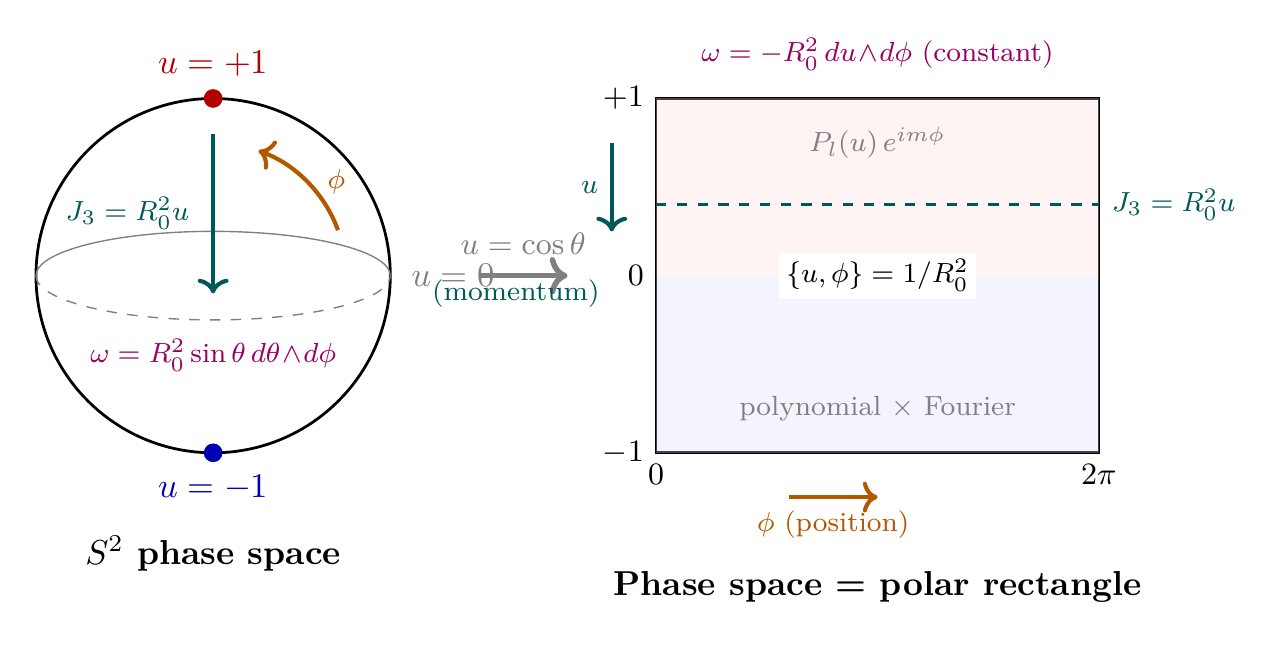
The symplectic structure on \(S^2\) takes its most transparent form in the polar field variable \(u = \cos\theta\). Since \(du = -\sin\theta\,d\theta\), the symplectic form (Eq. eq:ch58-symplectic-form) becomes:
This is the standard Darboux form with constant coefficients. The \(\sin\theta\) factor in the spherical expression was entirely a coordinate artifact—the symplectic structure on \(S^2\) is intrinsically flat in the polar variable. The total symplectic volume becomes an elementary rectangle integral:
The Poisson bracket on \(S^2\) becomes the standard canonical form in the polar variable:
The polar variable \(u\) and the azimuthal angle \(\phi\) are canonically conjugate on \(S^2\): the phase space of the 2-sphere IS the polar rectangle \([-1,+1]\times[0,2\pi)\) with constant symplectic area element \(du\,d\phi\).
Property | Spherical \((\theta, \phi)\) | Polar \((u, \phi)\) |
|---|---|---|
| Symplectic form | \(R_0^2\sin\theta\,d\theta\wedge d\phi\) | \(-R_0^2\,du\wedge d\phi\) |
| Coefficient | \(R_0^2\sin\theta\) (variable) | \(R_0^2\) (constant) |
| Area element | \(\sin\theta\,d\theta\,d\phi\) (curved) | \(du\,d\phi\) (flat) |
| Position variable | \(\phi \in [0,2\pi)\) | \(\phi \in [0,2\pi)\) |
| Momentum variable | \(\cos\theta\) (implicit) | \(u\) (explicit) |
| Canonical bracket | \(\\cos\theta,\phi\ = 1/R_0^2\) | \(\{u,\phi\} = 1/R_0^2\) |
| Total volume | \(\int\sin\theta\,d\theta\,d\phi\) | \(\int du\,d\phi = 4\pi\) |
The polar field variable \(u = \cos\theta\) is not merely a convenient substitution—it is the natural canonical momentum on \(S^2\). The Darboux theorem guarantees that every symplectic manifold admits local canonical coordinates; the polar variable provides a global Darboux chart on \(S^2\) minus the poles, with the symplectic form having constant coefficients everywhere on the interior.
Scaffolding note: The polar field variable \(u = \cos\theta\) is a coordinate choice, not a new physical assumption. The fact that \((S^2, \omega)\) becomes a flat rectangle \([-1,+1]\times[0,2\pi)\) in these coordinates verifies that the symplectic structure is the same—the \(\sin\theta\) factor in the spherical representation was a coordinate artifact. All physical results (conservation laws, mode spectra, quantization) are identical in both coordinate systems.
Phase Space Coordinates
The symplectic structure on \(S^2\) defines canonical coordinates. Using the Darboux-like coordinates \((q,p)=(\phi,\cos\theta)\), the symplectic form becomes:
In these coordinates:
- \(q=\phi\in[0,2\pi)\) plays the role of a “position” (azimuthal angle)
- \(p=\cos\theta\in[-1,1]\) plays the role of the conjugate “momentum” (related to the \(z\)-component of angular momentum)
Note that \(p = \cos\theta = u\): the Darboux momentum IS the polar field variable. The “natural” phase space coordinates on \(S^2\) discovered by the Darboux construction are precisely the polar coordinates \((u, \phi)\).
The Poisson bracket on \(S^2\) is:
The Classical Hamiltonian on \(S^2\)
For a scalar field \(\Phi\) on \(M^4\times S^2\), the \(S^2\) dynamics are governed by the Laplacian on the sphere. The classical Hamiltonian for the \(S^2\) sector is:
Mode Decomposition and Energy Spectrum
The eigenfunctions of \(\mathcal{H}_{S^2}\) are the spherical harmonics \(Y_{lm}(\theta,\phi)\):
The corresponding energy spectrum on \(S^2\) is:
The classical dynamics on \(S^2\) produce a discrete energy spectrum \(E_l=l(l+1)/(2R_0^2)\) with the following mode classification relevant to TMT:
| \(l\) | Modes | Energy | Physical Role |
|---|---|---|---|
| 0 | 1 | 0 | Modulus (size of \(S^2\)) |
| 1 | 3 | \(1/R_0^2\) | Gauge modes (absorbed into \(SU(2)\)) |
| \(2\)–\(11\) | 140 | \(3/R_0^2\) to \(66/R_0^2\) | Stiffness modes |
| \(\geq 12\) | — | \(\geq 78/R_0^2\) | Truncated by topological cutoff |
The topological cutoff \(l_{\max}=D\chi-1=11\) ensures a finite number of physical modes.
Step 1: The eigenvalue equation \(-\Delta_{S^2}Y_{lm}=l(l+1)Y_{lm}\) is the standard result for the Laplacian on \(S^2\) (ESTABLISHED).
Step 2: The mode classification follows from the physical role of each \(l\)-level in the TMT framework:
- \(l=0\): The single mode represents the overall size of \(S^2\), i.e., the modulus field \(\Phi\).
- \(l=1\): The three modes correspond to the three Killing vectors of \(S^2\) and are absorbed into the \(SU(2)\) gauge structure (Part 3, Theorem 7.5; Part 5 \S22.2).
- \(l=2\) to \(l=11\): Shape deformation modes that contribute to gravitational stiffness (Part 5 \S22).
Step 3: The topological cutoff \(l_{\max}=D\chi-1\) is derived in Part 5 \S22.3 from the requirement that the total mode count equals \((D\times\chi)^2=144\), giving \(l_{\max}=11\) for \(D=6\), \(\chi(S^2)=2\).
Step 4: The mode sum for \(l=2\) to \(l=11\): \(\sum_{l=2}^{11}(2l+1)=140\). These are the stiffness modes that generate the cosmic hierarchy \(M_{\mathrm{Pl}}/H=e^{140.21}\) (Chapter 57).
(See: Part 3 \S7, Part 5 \S22) □
Polar Mode Decomposition: Polynomial \(\times\) Fourier
In the polar field variable \(u = \cos\theta\), the spherical harmonics decompose as:
- THROUGH factor: \(P_l^{|m|}(u)\) — a polynomial of degree \(l\) in the polar variable \(u \in [-1,+1]\). This carries the mass/gravitational physics (radial \(S^2\) structure).
- AROUND factor: \(e^{im\phi}\) — a Fourier mode with winding number \(m \in \{-l,\ldots,+l\}\). This carries the gauge/charge physics (azimuthal winding).
Orthogonality follows from the flat measure \(du\,d\phi\):
The mode classification from Theorem thm:P10-Ch58-spectrum acquires a transparent polar interpretation:
\(l\) | THROUGH (polynomial) | AROUND (Fourier) | Physical Role |
|---|---|---|---|
| 0 | \(P_0(u) = 1\) (constant) | \(m = 0\) only | Modulus (uniform on rectangle) |
| 1 | \(P_1(u) = u\) (linear) | \(m = 0, \pm 1\) | Gauge (\(u\)-gradient + winding) |
| \(2\)–\(11\) | \(P_l(u)\) (degree \(l\)) | \(|m| \leq l\) | Stiffness (polynomial \(\times\) Fourier) |
The Laplacian eigenvalue equation becomes the Legendre equation in \(u\):
Phase Space Volume and Quantization
The symplectic structure on \(S^2\) connects to the quantization of angular momentum. The total phase space volume is:
By the Bohr–Sommerfeld quantization condition, the number of quantum states in a phase space region of volume \(V\) is \(V/(2\pi\hbar)\) (for each degree of freedom). For \(S^2\):
In TMT, with \(R_0=L_\xi\approx81\,\mu\text{m}\), the mode spectrum is extremely dense at macroscopic scales but is truncated at \(l_{\max}=11\) by the topological cutoff, giving a total of \((l_{\max}+1)^2=144\) modes.
Momentum Maps and Conservation
The \(SO(3)\) Action on \(S^2\)
The isometry group of the round \(S^2\) is \(\mathrm{Iso}(S^2) =O(3)\), with connected component \(SO(3)\) (Part 3, Theorem 7.1). The action of \(SO(3)\) on \(S^2\) is by rotations: each element \(R\in SO(3)\) acts as a diffeomorphism \(R:S^2\to S^2\) that preserves the metric and the symplectic form.
Step 1: The symplectic form \(\omega=R_0^2\sin\theta\, d\theta\wedge d\phi\) is the area form induced by the metric \(g\).
Step 2: An isometry preserves the metric: \(R^*g=g\).
Step 3: The area form is determined by the metric (it is the Riemannian volume form on a 2-manifold): \(\omega=\sqrt{\det(g_{ij})}\,d\theta\wedge d\phi\).
Step 4: Since \(R^*g=g\), the pullback preserves \(\sqrt{\det(g_{ij})}\), and therefore \(R^*\omega=\omega\).
(See: Part 3 \S7.1–7.2) □
Killing Vectors as Hamiltonian Vector Fields
The three Killing vector fields on \(S^2\) (Part 3, Theorem 7.2):
Each Killing vector field is a Hamiltonian vector field with respect to the symplectic form \(\omega\).
The \(SO(3)\) action on \((S^2,\omega)\) admits a momentum map \(\mu:S^2\to\mathfrak{so}(3)^*\cong\mathbb{R}^3\) given by:
Step 1: For \(\xi_3=\partial_\phi\), compute the contraction \(\iota_{\xi_3}\omega\):
Step 2: For \(\xi_1=-\sin\phi\,\partial_\theta -\cot\theta\cos\phi\,\partial_\phi\):
Step 3: By an identical calculation (or by using the rotation \(\phi\to\phi+\pi/2\)): \(J_2=R_0^2\sin\theta\sin\phi\).
Step 4: The Poisson brackets follow from the definition (Eq. eq:ch58-poisson):
Step 5: The momentum map \(\mu=R_0^2(\sin\theta\cos\phi,\sin\theta\sin\phi,\cos\theta)\) is equivariant: \(\mu\circ R = \mathrm{Ad}^*_R\circ\mu\) for all \(R\in SO(3)\), where \(\mathrm{Ad}^*\) is the coadjoint action. This is verified by noting that \(\mu\) is simply \(R_0^2\) times the embedding \(S^2\hookrightarrow\mathbb{R}^3\), and \(SO(3)\) acts on \(\mathbb{R}^3\) by the standard representation.
(See: Part 3 \S7.2, standard symplectic geometry) □
Polar Field Form of the Momentum Map
The momentum map acquires its most revealing form in the polar field variable \(u = \cos\theta\). The three angular momentum components (Eqs. eq:ch58-J1–eq:ch58-J3) become:
This is the crown jewel of the polar reformulation for this chapter: the \(z\)-component of angular momentum \(J_3\) is linear in the polar variable—it IS the coordinate \(u\) (up to the scale \(R_0^2\)). The Darboux canonical momentum \(p = u\) and the angular momentum \(J_3\) are the same quantity:
Meanwhile, \(J_1 + iJ_2\) factorizes into THROUGH \(\times\) AROUND: the modulus \(\sqrt{1-u^2}\) depends only on \(u\) (THROUGH direction, maximum at the equator \(u = 0\), vanishing at the poles \(u = \pm 1\)), while the phase \(e^{i\phi}\) depends only on \(\phi\) (AROUND direction, winding number \(+1\)).
Component | Spherical | Polar | Character | Physical Role |
|---|---|---|---|---|
| \(J_3\) | \(R_0^2\cos\theta\) | \(R_0^2 u\) (linear) | Pure THROUGH | Unbroken \(U(1)_{\mathrm{em}}\) |
| \(J_1\) | \(R_0^2\sin\theta\cos\phi\) | \(R_0^2\sqrt{1{-}u^2}\cos\phi\) | Mixed T\(\times\)A | Broken \(W^\pm\) (real) |
| \(J_2\) | \(R_0^2\sin\theta\sin\phi\) | \(R_0^2\sqrt{1{-}u^2}\sin\phi\) | Mixed T\(\times\)A | Broken \(W^\pm\) (imag) |
| \(|\mathbf{J}|^2\) | \(R_0^4\) | \(R_0^4\) | Casimir | Conserved magnitude |
The Poisson algebra (Eq. eq:ch58-poisson-algebra) is verified directly from the canonical bracket \(\{u,\phi\} = 1/R_0^2\):
The polar reformulation makes the gauge structure geometrically literal:
- \(J_3\) conservation: The THROUGH coordinate \(u\) is conserved under \(\phi\)-rotations — this is trivially evident from \(\{u, \mathcal{H}\} = 0\) for any \(\phi\)-independent Hamiltonian. In 4D, this becomes conservation of the unbroken \(U(1)_{\mathrm{em}}\) charge.
- \(J_1, J_2\) mix THROUGH and AROUND: The broken generators couple \(u\)-position to \(\phi\)-winding. Electroweak mixing IS around-through mixing on the polar rectangle (Chapter 15, \Ssec:ch58-polar-momentum-map).
Conservation Laws from Isometries
The momentum map provides the conservation laws on \(S^2\).
For any \(SO(3)\)-invariant Hamiltonian \(\mathcal{H}\) on \(S^2\), the three angular momentum components \(J_1,J_2,J_3\) are conserved:
Step 1: By the definition of the Poisson bracket, if \(\mathcal{H}\) is \(SO(3)\)-invariant, then \(\mathcal{L}_{\xi_a} \mathcal{H}=0\) for each Killing vector \(\xi_a\).
Step 2: Since \(\xi_a\) is the Hamiltonian vector field of \(J_a\), we have \(\mathcal{L}_{\xi_a}\mathcal{H} =\{J_a,\mathcal{H}\}\).
Step 3: Therefore \(\{J_a,\mathcal{H}\}=0\), and \(J_a\) is conserved along the Hamiltonian flow.
Step 4: The Casimir property: \(J_1^2+J_2^2+J_3^2=R_0^4(\sin^2\theta\cos^2\phi +\sin^2\theta\sin^2\phi+\cos^2\theta)=R_0^4\) is constant on \(S^2\), hence trivially conserved.
(See: Noether's theorem, standard symplectic geometry) □
Physical Significance for TMT
The classical dynamics on \(S^2\) have direct physical consequences in the TMT framework:
(1) Gauge symmetry from conservation: The three conserved angular momentum components \(J_1,J_2,J_3\) on \(S^2\) become the three generators of the \(SU(2)\) gauge symmetry in 4D. The Killing vectors \(\xi_a\) on \(S^2\) become gauge fields \(A_\mu^a(x)\) through the Kaluza–Klein mechanism (Part 3, Theorem 7.6):
(2) Mode structure determines physics: The discrete energy spectrum \(E_l=l(l+1)/(2R_0^2)\) determines which modes are physical:
- The \(l=0\) mode governs the modulus dynamics (inflation, dark energy)
- The \(l=1\) modes become gauge bosons
- The \(l\geq 2\) modes generate the cosmic hierarchy
(3) Phase space volume constrains quantization: The finite phase space volume \(4\pi R_0^2\) of \(S^2\), combined with the topological cutoff \(l_{\max}=11\), gives exactly 144 quantum states. This is the origin of the \((D\chi)^2=144\) formula that determines the cosmic hierarchy (Part 5 \S22.3).
| \(S^2\) Structure | 4D Physics | Source |
|---|---|---|
| Isometry \(SO(3)\) | \(SU(2)\) gauge symmetry | Part 3 \S7 |
| Killing vectors \(\xi_a\) | Gauge fields \(A_\mu^a\) | Part 3 \S7.4 |
| Momentum map \(J_a\) | Conserved charges | This chapter |
| Mode spectrum \(E_l\) | Particle/stiffness modes | Part 5 \S22 |
| Symplectic volume \(4\pi R_0^2\) | \((D\chi)^2=144\) states | Part 5 \S22.3 |
Chapter Summary
Classical Dynamics on \(S^2\)
The round 2-sphere \((S^2,\omega)\) is a compact symplectic manifold with the area form as its symplectic structure. The \(SO(3)\) isometry group acts as symplectomorphisms, with the momentum map \(\mu:S^2\to\mathbb{R}^3\) providing three conserved angular momentum components \(J_a=R_0^2\hat{x}_a\) that satisfy \(\{J_a,J_b\}=\epsilon_{abc}J_c\). The mode spectrum \(E_l=l(l+1)/(2R_0^2)\) classifies fields into the modulus (\(l=0\)), gauge (\(l=1\)), and stiffness (\(l\geq 2\)) sectors. These structures directly determine the 4D physics: gauge symmetry from Killing vectors, the cosmic hierarchy from the stiffness mode count (140), and the modulus dynamics that drive inflation and dark energy.
Polar verification: In the polar field variable \(u = \cos\theta\), the symplectic form becomes the constant-coefficient Darboux form \(\omega = -R_0^2\,du\wedge d\phi\), revealing that the \(S^2\) phase space IS the flat rectangle \([-1,+1]\times[0,2\pi)\) with canonical pair \((u,\phi)\) satisfying \(\{u,\phi\}=1/R_0^2\). The \(z\)-angular momentum \(J_3 = R_0^2 u\) is linear in the polar variable, and the mode decomposition factorizes as polynomial (THROUGH) \(\times\) Fourier (AROUND) on the flat domain (Figure fig:ch58-polar-phase-space).
| Result | Value | Status | Reference |
|---|---|---|---|
| \(S^2\) symplectic | \(\omega=R_0^2\sin\theta\,d\theta\wedge d\phi\) | ESTABLISHED | Thm thm:P3-Ch58-symplectic |
| Momentum map | \(\mu=R_0^2\hat{x}\) | PROVEN | Thm thm:P3-Ch58-momentum-map |
| \(SO(3)\) conservation | \(\{J_a,\mathcal{H}\}=0\) | ESTABLISHED | Thm thm:P3-Ch58-noether |
| Mode spectrum | \(E_l=l(l+1)/(2R_0^2)\) | PROVEN | Thm thm:P10-Ch58-spectrum |
| Phase space \(\to\) 4D | Table tab:ch58-dynamics-physics | PROVEN | \Ssec:ch58-momentum-maps |
| Polar symplectic | \(\omega = -R_0^2\,du\wedge d\phi\) (constant) | PROVEN | \Ssec:ch58-polar-symplectic |
| Polar \(J_3\) | \(J_3 = R_0^2 u\) (linear) | PROVEN | \Ssec:ch58-polar-momentum-map |
| Polar modes | \(P_l^{|m|}(u)\,e^{im\phi}\) (poly \(\times\) Fourier) | PROVEN | \Ssec:ch58-polar-modes |
Verification Code
The mathematical derivations and proofs in this chapter can be independently verified using the formal and computational scripts below.
All verification code is open source. See the complete verification index for all chapters.