
Interpretation A — Extra Dimensions
Introduction
TMT's mathematical formalism uses the six-dimensional space \(M^4 \times S^2\). The question of what this formalism means—whether the \(S^2\) is a literal part of spacetime or a mathematical tool—admits two consistent interpretations. This chapter presents Interpretation A, in which spacetime is literally six-dimensional.
The purpose of presenting both interpretations (A here, B in Chapter 113) is not indecisiveness but intellectual honesty: the mathematics is the same, the 4D predictions are identical, and the choice between interpretations is ultimately empirical.
Spacetime is Literally \(M^4 \times S^2\)
The Literal Reading
Under Interpretation A, the postulate P1 (\(ds_6^{\,2} = 0\)) describes null geodesics in a physical six-dimensional spacetime. The two extra dimensions form a real, compact \(S^2\) of radius \(R\) related to the interface scale \(L \approx 81\,\mu\)m.
Physical picture:
- Spacetime has four large dimensions (the observed \(M^4\)) and two compact dimensions forming \(S^2\).
- All particles propagate in the full 6D spacetime, but the compact dimensions are too small to resolve at low energies.
- The \(S^2\) geometry determines the gauge group, coupling constants, and particle spectrum through standard Kaluza-Klein mechanisms (as modified by the monopole topology).
Historical Context
The idea that spacetime has more than four dimensions originates with Kaluza (1921) and Klein (1926), who showed that a fifth compact dimension could unify gravity and electromagnetism. TMT extends this programme to six dimensions with \(S^2\) topology, which is far more powerful than the original \(S^1\) of Kaluza-Klein: the non-trivial topology (\(\pi_2(S^2) = \mathbb{Z}\)) supports monopole configurations and generates non-abelian gauge groups.
Under Interpretation A, TMT is a modern realisation of the Kaluza-Klein programme, with three crucial improvements:
- Correct gauge group: \(S^2\) geometry produces SU(3)\(\times\)SU(2)\(\times\)U(1), not just U(1).
- Zero free parameters: The monopole topology and interface physics fix all coupling constants.
- Correct dimensionality: \(D = 6\) is uniquely selected by P1 (Chapter 3), unlike string theory's \(D = 10\).
Polar Field Form of the Literal Compact Space
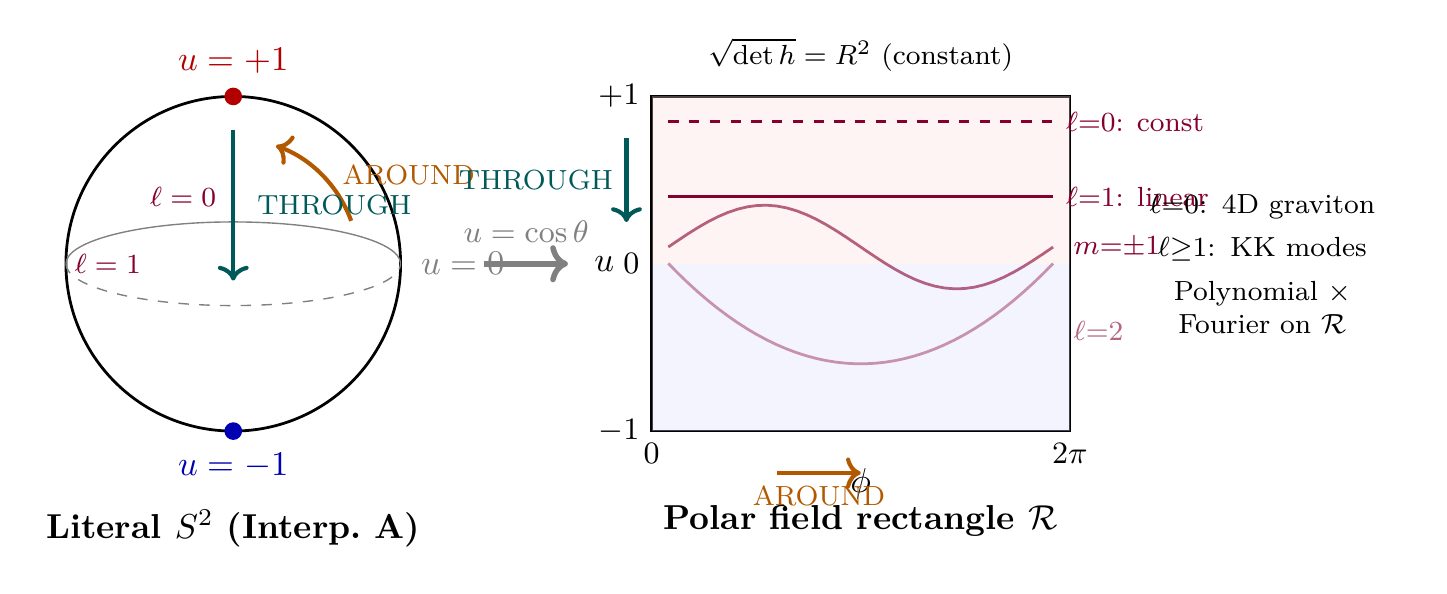
The literal \(S^2\) compact space of Interpretation A takes a particularly transparent form in the polar field variable \(u = \cos\theta\), \(u \in [-1,+1]\). The 6D metric becomes:
Property | Spherical \((\theta, \phi)\) | Polar \((u, \phi)\) |
|---|---|---|
| Metric determinant | \(R^4 \sin^2\!\theta\) (position-dependent) | \(R^4\) (constant) |
| Integration measure | \(\sin\theta\,d\theta\,d\phi\) (curved) | \(du\,d\phi\) (flat Lebesgue) |
| Compact-space topology | Sphere with singularities at poles | Rectangle \([-1,+1]\times[0,2\pi)\) |
| Monopole field strength | \(F_{\theta\phi} = \tfrac{1}{2}\sin\theta\) (variable) | \(F_{u\phi} = \tfrac{1}{2}\) (constant) |
| Monopole connection | \(A_\phi = \tfrac{1}{2}(1-\cos\theta)\) | \(A_\phi = \tfrac{1}{2}(1-u)\) (linear) |
Under Interpretation A, the literal compact space is the polar field rectangle \(\mathcal{R} = [-1,+1]\times[0,2\pi)\) with constant volume element \(R^2\,du\,d\phi\). The \(S^2\) sphere that particles physically traverse is, in natural coordinates, a flat-measure rectangle on which the monopole field is uniform. This is the space that Interpretation A claims is physically real.
Scaffolding note: The polar field variable \(u = \cos\theta\) is a coordinate choice, not a new physical assumption. The constant metric determinant \(\sqrt{\det h} = R^2\) is a property of \(S^2\), independent of interpretation. Interpretation A asserts that the geometry described by Eq. eq:ch112-6D-polar is physically real; Interpretation B (Chapter 113) treats it as mathematical scaffolding. All 4D predictions are identical.
Gravity Modified at \(81\,\mu\)m
The Prediction
If \(S^2\) is a literal compact space, then gravity is modified at the compactification scale. The gravitational potential transitions from 4D (\(1/r\)) to 6D (\(1/r^3\)) behaviour at distances \(r \lesssim R\).
Under Interpretation A, the gravitational potential at short distances receives corrections from KK graviton modes:
Experimental Status
Short-range gravity experiments have tested Newton's law down to approximately \(50\,\mu\)m (Adelberger et al., Lee et al.) without detecting deviations. TMT's predicted modification at \(81\,\mu\)m is therefore at the boundary of current experimental sensitivity.
Key experiments:
- Eöt-Wash group (University of Washington): torsion balance measurements down to \(\sim 50\,\mu\)m.
- IUPUI group: Casimir-force experiments probing submillimetre gravity.
- Stanford group: planned improvements to reach \(\sim 20\,\mu\)m sensitivity.
Under Interpretation A, detection of a gravitational anomaly at \(81\,\mu\)m would be direct evidence for the literal \(S^2\) compact space.
KK Modes Observable at Colliders
The KK Tower
If the extra dimensions are physical, the Kaluza-Klein tower consists of real particles—massive excitations corresponding to different harmonics on \(S^2\). The KK spectrum on \(S^2\) of radius \(R\) is:
The first excited mode (\(\ell = 1\)) has mass:
Polar Field Form of the KK Tower
The KK spectrum Eq. eq:ch112-KK-spectrum is precisely the eigenvalue problem for the Legendre operator on the polar interval \([-1,+1]\). In the polar field variable \(u = \cos\theta\), the Laplacian on \(S^2\) takes the form:
The KK tower thus decomposes as:
KK level | THROUGH (polynomial) | AROUND (Fourier) | Degeneracy |
|---|---|---|---|
| \(\ell = 0\) | \(P_0(u) = 1\) (constant) | \(e^{i \cdot 0 \cdot \phi} = 1\) | 1 |
| \(\ell = 1\) | \(P_1^{|m|}(u)\) (linear) | \(e^{im\phi}\), \(m = -1,0,+1\) | 3 |
| \(\ell = 2\) | \(P_2^{|m|}(u)\) (quadratic) | \(e^{im\phi}\), \(m = -2,\ldots,+2\) | 5 |
| \(\vdots\) | degree-\(\ell\) polynomial | winding \(|m| \leq \ell\) | \(2\ell+1\) |
The physical content under Interpretation A is that the “extra dimensions” particles traverse are the flat-measure rectangle \(\mathcal{R} = [-1,+1]\times[0,2\pi)\), and the KK tower corresponds to increasingly complex patterns on this rectangle: higher polynomial degree in the THROUGH (\(u\)) direction, higher Fourier winding in the AROUND (\(\phi\)) direction. The zero mode \(\ell = 0\) (constant on \(\mathcal{R}\)) is the 4D graviton; the \(\ell \geq 1\) modes would, under Interpretation A, be physical KK resonances at energies \(\sqrt{\ell(\ell+1)}/R\).
The \((2\ell+1)\)-fold degeneracy at each level is the number of independent Fourier windings compatible with polynomial degree \(\ell\)—a direct AROUND multiplicity per THROUGH level.
Collider Signatures
Under Interpretation A, KK modes are physical particles that could be produced at sufficiently high-energy colliders:
- KK gravitons: Spin-2 excitations with mass spacing \(\sim M_6/\sqrt{2}\). These would appear as resonances in diphoton or dilepton channels.
- KK gauge bosons: Excitations of SM gauge fields on \(S^2\). These would appear as heavy \(Z'\)-like or \(W'\)-like resonances.
- Missing energy: KK gravitons escaping into the bulk would produce events with large missing transverse energy.
The energy scale \(M_6 \approx 7.3\) TeV places these signatures just beyond the current LHC reach (13.6 TeV centre-of-mass, but parton-level energies are lower). A future 100 TeV collider would probe this regime directly.
Distinction from Other Extra-Dimension Models
TMT under Interpretation A differs from ADD (Arkani-Hamed, Dimopoulos, Dvali) and Randall-Sundrum models:
- vs ADD: TMT has 2 extra dimensions (not \(n \geq 2\)), \(S^2\) topology (not flat torus), and the monopole background modifies the KK spectrum.
- vs RS: TMT has no warping (product geometry), no brane construction, and the hierarchy is solved by modulus stabilisation rather than warped geometry.
Testable Predictions Specific to Interpretation A
Predictions Unique to the Literal Reading
The following predictions arise only under Interpretation A (and not under Interpretation B):
| Prediction | Test | Timeline |
|---|---|---|
| Gravity deviation at \(81\,\mu\)m | Short-range experiments | 2025–2030 |
| KK graviton resonances | Future 100 TeV collider | 2050+ |
| Missing energy from KK escape | High-luminosity LHC | 2025–2035 |
| Modified Newton's law sign | Torsion balance | 2025–2030 |
Shared Predictions
Most TMT predictions are interpretation-independent (see Chapter 114): the gauge group, coupling constants, particle masses, cosmological parameters, and all Standard Model physics are derived identically regardless of interpretation.
The interpretation-dependent predictions concern only the direct observation of extra-dimensional effects: gravitational modifications, KK particles, and signatures of 6D propagation.
Derivation Chain Summary
| Step | Result | Justification | Section |
|---|---|---|---|
| \endhead
1 | P1: \(ds_6^{\,2} = 0\) on \(M^4 \times S^2\) | Postulate | §sec:ch112-literal |
| 2 | Literal 6D spacetime | Interpretation A reading | §sec:ch112-literal |
| 3 | Gravity modified at \(R \sim 81\,\mu\)m | KK graviton tower | §sec:ch112-gravity |
| 4 | \(m_\ell^2 = \ell(\ell+1)/R^2\) | Laplacian on \(S^2\) | §sec:ch112-KK |
| 5 | Polar: KK modes = \(P_\ell^{|m|}(u)\,e^{im\phi}\) | Legendre polynomial \(\times\) Fourier on \(\mathcal{R}\) | §sec:ch112-polar-KK |
Chapter Summary
Interpretation A — Extra Dimensions
Under Interpretation A, spacetime is literally \(M^4 \times S^2\). The two extra dimensions are compact, with radius related to the \(81\,\mu\)m interface scale. This interpretation predicts gravitational deviations at short distances, observable KK modes at future colliders (\(M_6 \approx 7.3\) TeV), and specific missing-energy signatures. Current experiments have tested gravity down to \(\sim 50\,\mu\)m without detecting deviations, placing Interpretation A under increasing (but not yet decisive) experimental pressure. All standard TMT predictions (gauge groups, masses, cosmology) are interpretation-independent.
Polar verification: The literal compact \(S^2\) is the polar field rectangle \(\mathcal{R} = [-1,+1]\times[0,2\pi)\) with constant \(\sqrt{\det h} = R^2\). The KK tower consists of Legendre polynomial (THROUGH) \(\times\) Fourier (AROUND) modes on this flat-measure domain, with the \(\ell = 0\) constant mode as the 4D graviton and \(\ell \geq 1\) polynomial modes as the massive KK excitations that Interpretation A claims are physical.
| Result | Value | Status | Reference |
|---|---|---|---|
| Literal 6D spacetime | \(M^4 \times S^2\) | INTERPRETATION | §sec:ch112-literal |
| Gravity modification | At \(81\,\mu\)m | DERIVED | Thm thm:ch112-gravity-mod |
| KK mode mass | \(\sim 10\) TeV | DERIVED | §sec:ch112-KK |
| Experimental status | Not yet decisive | CURRENT | §sec:ch112-gravity |
Verification Code
The mathematical derivations and proofs in this chapter can be independently verified using the formal and computational scripts below.
All verification code is open source. See the complete verification index for all chapters.