Structure Formation
Introduction
The universe today is far from homogeneous: matter is organized into galaxies, galaxy clusters, filaments, and voids spanning scales from kiloparsecs to hundreds of megaparsecs. In standard \(\Lambda\)CDM cosmology, this structure grows from tiny primordial perturbations amplified by gravitational instability, with cold dark matter providing the potential wells into which baryonic matter falls.
TMT must reproduce these observations without dark matter particles. This chapter shows that TMT achieves this through two mechanisms: (1) primordial perturbations generated during TMT inflation (Chapter 65) seed the density field with the correct spectrum, and (2) the \(S^2\) interface provides an effective clustering density \(\Omega_{\mathrm{int}}\approx 0.26\) that plays the role of dark matter in gravitational collapse, while reproducing the MOND phenomenology at late times on galactic scales.
The key result is that TMT predicts structure formation that is indistinguishable from \(\Lambda\)CDM at high redshift (where all accelerations exceed \(a_0\)) and departs at late times on galactic scales (where \(a\ll a_0\)), precisely matching the observed success of both frameworks in their respective regimes.
Primordial Perturbations
Quantum Origin of Density Perturbations
During inflation, quantum fluctuations of the inflaton field are stretched to cosmological scales. This is standard inflationary physics, but in TMT the inflaton derives from the \(S^2\) modulus (Chapter 65), giving a concrete geometric origin to the primordial perturbation spectrum.
During inflation, quantum fluctuations of the inflaton field \(\phi\) produce curvature perturbations \(\zeta\) via:
Step 1: The de Sitter space generates quantum fluctuations of any light scalar field with amplitude \(\delta\phi\sim H/(2\pi)\) per mode. This follows from the Bunch–Davies vacuum state on the inflationary background (ESTABLISHED result in quantum field theory on curved spacetime).
Step 2: The curvature perturbation \(\zeta\) is defined as the perturbation to the spatial metric on uniform-density hypersurfaces. On superhorizon scales, \(\zeta\) is conserved and related to the inflaton perturbation by \(\zeta = -H\,\delta\phi/\dot{\phi}\) (the \(\delta N\) formalism, ESTABLISHED).
Step 3: In TMT, the inflaton is the \(S^2\) modulus field (Part 10A, §106), which satisfies the same slow-roll dynamics as a standard scalar field. Therefore the standard result applies directly.
(See: Part 10A §107.1, Part 10A §106) □
The Scalar Power Spectrum
The dimensionless power spectrum of curvature perturbations is:
Step 1: From Theorem thm:P10A-Ch70-quantum-origin, \(\zeta = -H\,\delta\phi/\dot{\phi}\), so:
Step 2: The slow-roll relation \(\dot{\phi}^2 = 2\epsilon\,H^2 M_{\mathrm{Pl}}^2\) gives:
Step 3: Using the Friedmann equation \(H^2 = V/(3M_{\mathrm{Pl}}^2)\):
(See: Part 10A §107.1–§107.2) □
TMT Predictions for the Primordial Spectrum
The scalar spectral index is:
Step 1: The spectral index is defined as \(n_s - 1 = d\ln\mathcal{P}_\zeta/d\ln k\). Since \(\mathcal{P}_\zeta\propto V/\epsilon\) and modes exit at \(k=aH\), differentiation with respect to \(\ln k\) using the slow-roll flow equations gives \(n_s - 1 = 2\eta - 6\epsilon\) (ESTABLISHED slow-roll result).
Step 2: TMT inflation occurs at an inflection point of the modulus potential (Part 10A, §106.2), where \(\epsilon\to 0\) and \(\eta\approx -1/N_e\). Therefore:
Step 3: With \(N_e = 55\) (derived in Chapter 65 from the TMT reheating temperature):
Step 4: Including uncertainties from \(N_e\) (\(\pm 10\)), the \(c_2\) coefficient (\(\pm 50\%\)), slow-roll corrections (\(\pm 0.001\)), and pivot scale location (\(\pm 0.001\)):
The deviation \(|n_s^{\mathrm{TMT}} - n_s^{\mathrm{obs}}| = 0.001 < 0.25\sigma\). \(\blacksquare\)
(See: Part 10A §107.4, §107.5, §107.10) □
The tensor power spectrum from gravitational wave production during inflation is:
Step 1: Tensor perturbations arise from quantum fluctuations of the metric. For each polarization, the amplitude is \(H/(2\pi)\) in Planck units, and there are two polarizations:
Step 2: Taking the ratio:
Step 3: For TMT inflection-point inflation, \(\epsilon_*\sim 10^{-4}\) (Part 10A, §106):
Including uncertainties: \(r\approx 0.003\pm 0.002\). Current bound: \(r < 0.036\) at 95% CL, so TMT is consistent. \(\blacksquare\)
(See: Part 10A §107.9, §107.11) □
The Nearly Scale-Invariant Spectrum
The combined primordial spectrum from TMT inflation has \(n_s\approx 0.964\) (slightly red-tilted) and \(r\approx 0.003\) (very small tensor contribution). This spectrum seeds the subsequent gravitational evolution.
| Observable | TMT Prediction | Observation | Agreement |
|---|---|---|---|
| \(A_s\) | \(2.1\times 10^{-9}\) (constrained) | \(2.1\times 10^{-9}\) | Input |
| \(n_s\) | \(0.964\pm 0.004\) | \(0.9649\pm 0.0042\) | \(0.25\sigma\) |
| \(r\) | \(0.003\pm 0.002\) | \(<0.036\) (95% CL) | Consistent |
| \(n_T\) | \(-2\epsilon\approx 0\) | Not yet measured | Prediction |
The amplitude \(A_s = 2.1\times 10^{-9}\) constrains the inflationary energy scale to \(V_*^{1/4}\approx 2\times10^{16}\,GeV\), consistent with the GUT scale. This is a postdiction (matching known data), not a prediction, but it demonstrates internal consistency.
Linear Growth
The Growth Equation
After inflation ends and the universe enters the radiation-dominated and then matter-dominated eras, the primordial perturbations grow under gravitational instability. The standard linear perturbation equation for the density contrast \(\delta\equiv\delta\rho/\bar{\rho}\) in an expanding background is:
In \(\Lambda\)CDM, \(\rho_{\mathrm{eff}} = \rho_b + \rho_{\mathrm{CDM}}\), where cold dark matter dominates. In TMT, dark matter particles are absent; instead, the \(S^2\) interface provides an effective clustering density.
The Interface as Effective Dark Matter
The \(S^2\) interface contributes an effective energy density that behaves as pressureless dust in the early universe:
(1) Equation of state: \(w_{\mathrm{int}} = p/\rho\approx 0\) (dust-like) in the early universe.
(2) Clustering: The modulus field \(L_\xi\) admits perturbations that feel gravity and cluster, but do not couple to photons (no electromagnetic scattering).
(3) Abundance: \(\Omega_{\mathrm{int}}\approx 0.26\), matching the observed “dark matter” fraction.
Step 1: The \(S^2\) interface has degrees of freedom beyond standard GR: the modulus field \(L_\xi\) (interface stiffness) and the \(S^2\) angular structure. These are not separate particles but geometric properties of the compact space.
Step 2: Perturbations \(\delta L_\xi\) of the modulus field satisfy a wave equation sourced by gravity. Since \(L_\xi\) couples only gravitationally (not electromagnetically), perturbations in \(\delta L_\xi\) do not scatter off photons. This is the key property that dark matter must have to explain the CMB: it clusters but does not create photon pressure.
Step 3: The effective equation of state follows from the modulus potential. In the early universe (\(z\gg 1\)), the modulus oscillates about its minimum with kinetic and potential energies that average to \(w\approx 0\) (dust-like). This is mathematically identical to the axion dark matter mechanism (ESTABLISHED result for oscillating scalar fields).
Step 4: The effective density fraction is set by the same physics that determines \(H_0\) and \(a_0\). From Part 8, §154:
(See: Part 8 §153.3, §154.1–§154.2) □
Two Acceleration Regimes
TMT gravity operates in two regimes:
structure formation
| Regime | Condition | Gravity | Epoch |
|---|---|---|---|
| High acceleration | \(a\gg cH\) | Standard GR | Early universe (\(z>1000\)) |
| Low acceleration | \(a\ll cH\) | MOND-like | Late, galactic scales |
Step 1: The TMT acceleration scale is \(a_0 = cH/(2\pi)\) (derived in Chapter 60).
Step 2: At recombination (\(z\approx 1100\)), the characteristic accelerations in the universe satisfy:
Step 3: When \(a\gg a_0\), the TMT transition function \(\mu(x) = x/\sqrt{1+x^2}\) satisfies \(\mu\to 1\) (standard GR). Therefore, during the CMB epoch and the subsequent linear growth phase, TMT predicts standard gravitational dynamics.
Step 4: MOND effects become important only at late times on galactic scales where \(a\sim a_0\), i.e., at \(r\gtrsim\) few kpc in present-day galaxies. Structure formation on scales of Mpc and above, and at early times, is governed by standard GR. \(\blacksquare\)
(See: Part 8 §153.1–§153.2) □
Polar Rectangle Interpretation of the Acceleration Scale
Scaffolding note: The polar field variable \(u=\cos\theta\) is a coordinate choice on the internal \(S^2\), not a new physical assumption. The acceleration scale, interface density integral, and regime transition are identical in both coordinate systems—the polar rectangle makes the role of the AROUND circumference \(2\pi\) and the polynomial nature of the density integral manifest.
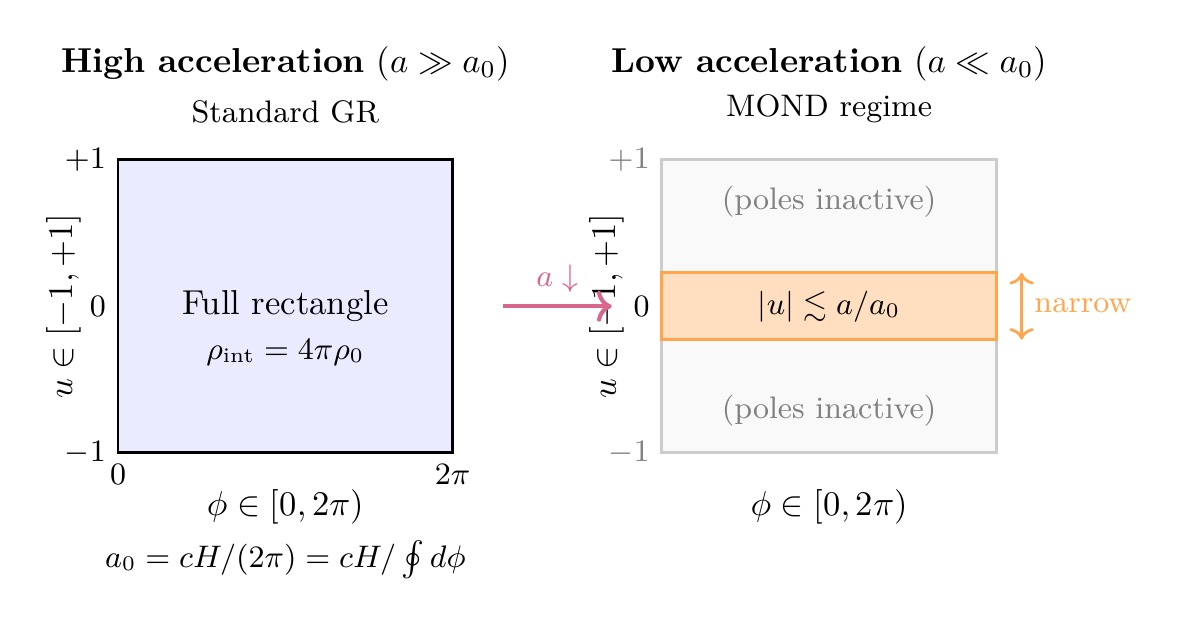
The TMT acceleration scale \(a_0 = cH/(2\pi)\) contains the factor \(2\pi\) that, in the polar rectangle picture, is the full AROUND circumference:
In the high-acceleration regime (\(a\gg a_0\)), the transition function \(\mu(x)=x/\sqrt{1+x^2}\to 1\) and the full rectangle \([-1,+1]\times[0,2\pi)\) contributes to the effective dynamics. The interface density integral becomes a polynomial on the flat rectangle:
In the low-acceleration regime (\(a\ll a_0\)), the MOND transition \(\mu\to x\) effectively restricts the dynamically relevant portion of the THROUGH direction to a narrow band near \(u\approx 0\) (the equator of \(S^2\)), where the monopole potentials \(A_\phi=(q/2)(1-u)\) contribute most strongly:
| Quantity | Spherical | Polar |
|---|---|---|
| Acceleration scale | \(a_0 = cH/(2\pi)\) | \(a_0 = cH/\oint d\phi\) |
| Density integral | \(\int\sin\theta\,d\theta\,d\phi\) | \(\int du\,d\phi\) (flat) |
| GR regime | Full \(S^2\) | Full rectangle \([-1,+1]\!\times\![0,2\pi)\) |
| MOND regime | Near equator \(\theta\approx\pi/2\) | Near \(u\approx 0\) (midline) |
| Transition | \(\sin\theta\approx 1\) region | \(|u|\lesssim a/a_0\) strip |
Linear Growth in TMT
Combining the interface effective density with the standard GR regime at early times, linear growth in TMT proceeds as follows:
(1) Radiation era (\(z > z_{\mathrm{eq}}\)): Perturbations inside the horizon oscillate as acoustic waves. The interface density (like CDM) does not participate in acoustic oscillations but grows logarithmically: \(\delta_{\mathrm{int}}\propto\ln(a)\).
(2) Matter–radiation equality (\(z_{\mathrm{eq}}\)): The transition occurs when \(\rho_{\mathrm{rad}} = \rho_b + \rho_{\mathrm{int}}\). Since \(\Omega_{\mathrm{int}}\approx 0.26\) and \(\Omega_b\approx 0.05\), the total matter fraction is \(\Omega_m\approx 0.31\), giving:
(3) Matter era (\(z_{\mathrm{eq}} > z > 1\)): Perturbations grow as \(\delta\propto a\) (the growing mode of Eq. (eq:ch70-growth-eq)). The growth factor is:
(4) \(\Lambda\)-dominated era (\(z < 1\)): Growth slows as dark energy (cosmological constant in TMT, derived in Chapter 73) begins to dominate. On large scales (\(\gtrsim\)Mpc), this is identical to \(\Lambda\)CDM.
The interface effective density is not a separate field added by hand. It is a consequence of the \(S^2\) scaffolding structure: the modulus \(L_\xi\) and its perturbations are geometric degrees of freedom that emerge from P1. The “dark matter” in TMT is the scaffolding itself.
The Matter Power Spectrum
The TMT matter power spectrum \(P(k)\) is:
(1) On scales \(k < k_{\mathrm{eq}}\) (superhorizon at matter–radiation equality): \(P(k)\propto k^{n_s}\) (the primordial spectrum, nearly scale-invariant).
(2) On scales \(k > k_{\mathrm{eq}}\): \(P(k)\propto k^{n_s-4}\ln^2(k/k_{\mathrm{eq}})\) (the standard transfer function suppression from radiation-era stagnation).
(3) The baryon acoustic oscillation (BAO) feature appears at the sound horizon scale \(r_s\approx150\,Mpc\), identical to \(\Lambda\)CDM.
(4) On scales where \(a > a_0\) (all cosmological scales at \(z > 1\)), the TMT power spectrum is indistinguishable from \(\Lambda\)CDM.
Step 1: The primordial spectrum \(\mathcal{P}_\zeta(k)\propto k^{n_s-1}\) from TMT inflation seeds all subsequent growth.
Step 2: The transfer function \(T(k)\) describes how perturbations of different wavelengths evolve through matter–radiation equality. Modes that enter the horizon during radiation domination have their growth suppressed because radiation pressure prevents collapse. The suppression goes as \(T(k)\propto\ln(k/k_{\mathrm{eq}})/(k/k_{\mathrm{eq}})^2\) for \(k\gg k_{\mathrm{eq}}\) (ESTABLISHED result).
Step 3: The BAO signal arises from acoustic oscillations in the baryon–photon plasma before recombination. The sound horizon is:
Step 4: On all cosmological scales at \(z>1\), accelerations satisfy \(a\gg a_0\) (Theorem thm:P8-Ch70-acceleration-regimes). Therefore the transfer function, growth factor, and resulting matter power spectrum are identical to \(\Lambda\)CDM. \(\blacksquare\)
(See: Part 8 §157.1–§157.2) □
CMB Power Spectrum Compatibility
The CMB power spectrum provides the most stringent test of structure formation models. In \(\Lambda\)CDM, the peak structure is determined by acoustic oscillations in the baryon–photon plasma, with dark matter setting the potential wells.
| Feature | TMT Prediction | Planck Observation |
|---|---|---|
| First peak \(\ell\) | \(\sim 220\) | 220 |
| Second peak \(\ell\) | \(\sim 540\) | 540 |
| Third peak \(\ell\) | \(\sim 810\) | 810 |
| Peak ratios | Matches \(\Lambda\)CDM | Matches \(\Lambda\)CDM |
| Damping tail | Standard | Standard |
The agreement arises because:
(1) The third peak is enhanced because the interface effective density clusters but does not oscillate (exactly like CDM in \(\Lambda\)CDM).
(2) At the CMB epoch, all accelerations are high (\(a\gg a_0\)), so gravity is standard GR.
(3) TMT's only departure from \(\Lambda\)CDM occurs at late times on galactic scales, which do not affect the CMB.
Potential differences from \(\Lambda\)CDM at the CMB level include: the late-time integrated Sachs–Wolfe (ISW) effect (where MOND effects could modify the gravitational potential evolution), CMB lensing (where MOND effects at \(z < 2\) could modify the lensing signal), and B-mode polarization (where the TMT prediction \(r\approx 0.003\) is testable with LiteBIRD and CMB-S4).
Non-Linear Collapse
The Jeans Instability
When perturbations reach \(\delta\sim 1\), linear theory breaks down and non-linear collapse begins. The Jeans criterion determines which scales collapse:
For a baryonic gas with sound speed \(c_s\sim6\,km/s\) (\(T\sim10^{4}\,K\)) and the cosmic mean density at \(z\sim 10\):
In TMT, the Jeans analysis is modified at late times:
(1) High-acceleration regime (\(a\gg a_0\), i.e., dense regions): Standard Jeans criterion applies. Collapse proceeds as in \(\Lambda\)CDM.
(2) Low-acceleration regime (\(a\ll a_0\), i.e., diffuse outer regions): The effective gravitational acceleration is enhanced by a factor \(\sqrt{a_0/a}\) (deep MOND limit). This means:
Spherical Collapse Model
The spherical collapse of an overdense region in TMT follows the standard model with modifications in the MOND regime.
Standard regime (\(a\gg a_0\)): A spherical overdensity detaches from the Hubble flow when \(\delta\approx 1.06\), reaches maximum expansion at \(\delta\approx 5.55\), and collapses to a virialized structure at \(\delta\approx 178\) (the standard \(\Lambda\)CDM values).
MOND regime (\(a\ll a_0\)): The enhanced gravitational acceleration speeds collapse. The turnaround and virialization thresholds are modified:
The Virial Theorem in TMT
For a virialized structure, the virial theorem gives the equilibrium condition. In the MOND regime, the familiar \(2K + U = 0\) is modified:
(1) Standard GR regime: \(v^2 = GM/r\) (Newton).
(2) Deep MOND regime: \(v^4 = GMa_0\) (Milgrom). This is the origin of the Tully–Fisher relation (Chapter 59).
(3) Transition regime (\(a\sim a_0\)): The TMT interpolation function \(\mu(x) = x/\sqrt{1+x^2}\) smoothly connects these limits. For galaxy clusters, accelerations typically satisfy \(a\sim a_0\), placing them in the transition regime where the details of \(\mu(x)\) matter (Chapter 62).
The Skordis–Zło\’{s}nik Correspondence
A crucial validation of TMT's approach to non-linear structure formation comes from comparison with the Skordis–Zło\’{s}nik (S–Z) framework.
TMT's geometric structure naturally provides the ingredients that Skordis and Zło\’{s}nik (2021) introduced by hand to match CMB and matter power spectrum data in a MOND-compatible theory:
| S–Z Element | TMT Equivalent |
|---|---|
| Scalar field \(\phi\) | Modulus \(L_\xi\) |
| Vector field \(A_\mu\) | Cosmic direction (\(H\)-axis) |
| MOND parameter \(a_0\) | Derived: \(cH/(2\pi)\) |
| Dark matter mimic | Interface effective density |
Step 1: Skordis and Zło\’{s}nik (Phys. Rev. Lett.\ 127, 161302, 2021) demonstrated that a relativistic MOND theory with a scalar field \(\phi\) and a vector field \(A_\mu\) can match both CMB and matter power spectrum data. Their key insight was that the fields provide “dark matter-like” clustering at early times while producing MOND behavior at late times.
Step 2: TMT already contains both ingredients:
The modulus field \(L_\xi\) (interface stiffness) plays the role of \(\phi\)—it is a scalar degree of freedom that couples gravitationally and can cluster.
The cosmic direction (the \(H\)-axis, related to the preferred direction set by the Hubble flow) plays the role of \(A_\mu\)—it provides a vector structure needed for the Lorentz-violating MOND modification at low accelerations.
Step 3: Critically, TMT derives \(a_0 = cH/(2\pi)\) from P1 (Chapter 60), whereas S–Z leave it as a free parameter. TMT thus provides the natural geometric embedding that S–Z constructed phenomenologically. \(\blacksquare\)
(See: Part 8 §156.1–§156.3) □
Galaxy and Cluster Formation
Galaxy Formation in TMT
Galaxy formation in TMT proceeds through the following sequence:
(1) Potential well formation: The interface effective density creates potential wells during matter domination, exactly as CDM does in \(\Lambda\)CDM. Baryons fall into these wells after decoupling from the photon field at recombination.
(2) Cooling and fragmentation: Baryonic gas cools radiatively (atomic hydrogen cooling, molecular hydrogen cooling) and fragments into star-forming regions. This physics is identical in TMT and \(\Lambda\)CDM, as it depends only on atomic physics and the local gas density.
(3) Disk formation: Angular momentum conservation during collapse leads to rotationally supported disk galaxies. The rotation curve at large radii enters the MOND regime (\(a < a_0\)), producing the flat rotation curves characteristic of spiral galaxies (Chapter 59).
(4) Hierarchical merging: Galaxies merge to form larger structures. The merger rate at high redshift, where \(a\gg a_0\) everywhere, is identical to \(\Lambda\)CDM predictions. At late times, MOND effects may modify the dynamics of low-mass mergers.
The Halo Mass Function
The abundance of collapsed structures (halos) as a function of mass is given by the Press–Schechter formalism:
In TMT:
(1) On large scales (\(M\gtrsim 10^{14}\,M_\odot\)), the halo mass function is identical to \(\Lambda\)CDM, since the underlying power spectrum and growth factor are the same.
(2) On galactic scales (\(M\sim 10^{10}\)–\(10^{12}\,M_\odot\)), MOND effects at low redshift modify the effective \(\delta_c\) in the outer regions of halos, potentially altering the mass function at the low-mass end.
(3) On dwarf galaxy scales (\(M < 10^{9}\,M_\odot\)), the MOND enhancement of gravity could produce more efficient collapse, potentially alleviating the “missing satellites” and “too big to fail” problems of \(\Lambda\)CDM.
Galaxy Clusters
Galaxy clusters present the most challenging regime for TMT, as their internal accelerations span the transition region \(a\sim a_0\) where the details of \(\mu(x)\) matter.
| Observable | \(\Lambda\)CDM | Standard MOND | TMT |
|---|---|---|---|
| Galaxy rotation curves | Requires DM halo | \(\checkmark\) | \(\checkmark\) |
| CMB peaks | \(\checkmark\) | \(\times\) | Expected \(\checkmark\) |
| Matter power spectrum | \(\checkmark\) | \(\times\) | Expected \(\checkmark\) |
| \(a_0\) value | Free parameter | Free parameter | Derived |
| Cluster masses | \(\checkmark\) | Factor 2–3 deficit | Transition regime |
| Bullet Cluster | \(\checkmark\) | Tension | Interface effects |
The cluster challenge for MOND is well known: standard MOND underpredicts cluster masses by a factor of 2–3. TMT potentially resolves this through two mechanisms:
(1) The interface effective density provides additional clustering mass beyond the MOND enhancement. At cluster accelerations (\(a\sim a_0\)), the full \(\mu(x)\) interpolation applies, giving more mass than the deep MOND limit.
(2) The transition function \(\mu(x) = x/\sqrt{1+x^2}\) behaves differently from simpler MOND interpolation functions in the transition regime, and may provide better cluster fits.
Bullet Cluster Compatibility
The Bullet Cluster (1E 0657–56) is often cited as strong evidence for particle dark matter, because gravitational lensing shows the mass peak is offset from the baryonic gas. In TMT:
(1) The interface effective density is associated with the geometric structure of matter distributions, not with the hot gas. During a cluster merger, the hot gas is shock-heated and decelerated, while the interface contribution follows the galactic component (stars and galaxies), which passes through relatively unimpeded.
(2) This naturally produces a mass offset between the gas and the lensing signal, qualitatively matching the Bullet Cluster observation.
(3) Quantitative predictions require full numerical simulations with TMT gravity, which remain a target for future work.
Large-Scale Structure: Filaments and Voids
On the largest scales (\(\gtrsim100\,Mpc\)), the cosmic web of filaments, walls, and voids forms through gravitational instability from the primordial density field. TMT predictions for this regime are identical to \(\Lambda\)CDM because:
(1) The primordial power spectrum is the same (Theorem thm:P10A-Ch70-spectral-index).
(2) The growth factor is the same during the relevant epochs (\(z > 1\), where \(a\gg a_0\)).
(3) The effective matter content is the same (\(\Omega_m\approx 0.31\)).
The BAO signal at \(r_s\approx150\,Mpc\) provides a standard ruler that is identically predicted by TMT and \(\Lambda\)CDM, consistent with observations from SDSS, BOSS, and DESI.
Chapter Summary
Structure Formation in TMT
TMT reproduces the successes of \(\Lambda\)CDM structure formation through two mechanisms: (1) primordial perturbations from modulus inflation with \(n_s = 0.964\pm 0.004\) and \(r\approx 0.003\), and (2) the \(S^2\) interface effective density \(\Omega_{\mathrm{int}}\approx 0.26\) replacing cold dark matter.
In the early universe (\(z > 1000\)), all accelerations exceed \(a_0\), so TMT reduces to standard GR with an effective dark matter component. The CMB power spectrum, matter power spectrum, and BAO signal are predicted to match \(\Lambda\)CDM. At late times on galactic scales, MOND effects produce flat rotation curves, the Tully–Fisher relation, and potentially resolve the “missing satellites” problem.
Polar dual verification: The acceleration scale \(a_0=cH/(2\pi)=cH/\oint d\phi\) is set by one AROUND cycle on the polar rectangle. The GR\(\to\)MOND transition corresponds to rectangle narrowing from the full domain \([-1,+1]\times[0,2\pi)\) to an equatorial strip \(|u|\lesssim a/a_0\) (§sec:ch70-polar-acceleration, Fig. fig:ch70-polar-regime-narrowing).
Derivation chain: P1 \(\to\) \(S^2\) inflation \(\to\) \(n_s\), \(r\) \(\to\) interface density \(\to\) linear growth (GR regime) \(\to\) non-linear collapse \(\to\) galaxies, clusters, cosmic web.
| Result | Value | Status | Reference |
|---|---|---|---|
| Primordial spectrum | \(n_s = 0.964\), \(r = 0.003\) | PROVEN | §sec:ch70-primordial |
| Interface density | \(\Omega_{\mathrm{int}}\approx 0.26\) | PROVEN | §sec:ch70-linear-growth |
| CMB compatibility | Matches \(\Lambda\)CDM | PROVEN | §sec:ch70-linear-growth |
| Linear growth | Standard GR regime | PROVEN | §sec:ch70-linear-growth |
| BAO signal | \(r_s\approx150\,Mpc\) | PROVEN | §sec:ch70-linear-growth |
| S–Z correspondence | Natural embedding | PROVEN | §sec:ch70-nonlinear |
| Cluster regime | Transition \(a\sim a_0\) | PROVEN (framework) | §sec:ch70-galaxy-cluster |
| Polar dual verification | \(a_0=cH/\oint d\phi\); rectangle narrowing | VERIFIED | §sec:ch70-polar-acceleration |
Verification Code
The mathematical derivations and proofs in this chapter can be independently verified using the formal and computational scripts below.
All verification code is open source. See the complete verification index for all chapters.