Gravitational Waves from Inflation
Introduction
Gravitational waves provide the most direct observational window into the inflationary epoch. Quantum fluctuations of the metric during inflation generate a stochastic background of primordial gravitational waves whose amplitude, spectral shape, and polarization encode the physics of the inflaton potential. The tensor-to-scalar ratio \(r\), the tensor spectral index \(n_T\), and the polarization content are all observable (in principle) through CMB B-mode polarization and future gravitational wave detectors.
This chapter derives TMT's predictions for the primordial gravitational wave spectrum, demonstrates that gravitational waves propagate at exactly \(c_{\mathrm{gw}}=c\) in TMT, establishes that only two polarization states (\(+\) and \(\times\)) are observable, and surveys detection prospects.
Tensor Perturbations
Gravitational Waves from 6D to 4D
In TMT, gravitational perturbations originate in the full 6D metric. The 6D metric perturbation \(h_{MN}\) decomposes into 4D fields:
| 6D Component | 4D Field | Spin | Degrees of Freedom |
|---|---|---|---|
| \(h_{\mu\nu}\) | 4D graviton (tensor) | 2 | 2 (TT gauge) |
| \(h_{\mu a}\) | Graviphoton (vector) | 1 | \(2\times 2 = 4\) |
| \(h_{ab}\) | Scalar modes | 0 | 3 |
Each 4D field expands in \(S^2\) harmonics. The physically observable gravitational wave is the \(l=0\) mode of \(h_{\mu\nu}\), which is constant on \(S^2\) and therefore identical to the standard GR graviton.
The 4D Graviton Wave Equation
Step 1: The linearized 6D Einstein equation in transverse-traceless gauge gives \(\Box_6\,h_{MN}=0\).
Step 2: On \(M^4\times S^2\), the 6D d'Alembertian splits:
Step 3: For the \(l=0\) spherical harmonic: \(\Delta_{S^2}Y_0^0 = 0\).
Step 4: Therefore \(\Box_4\,h_{\mu\nu}^{(4D)} = 0\), which is the standard massless graviton equation.
(See: Part 9A §179.3–179.4) □
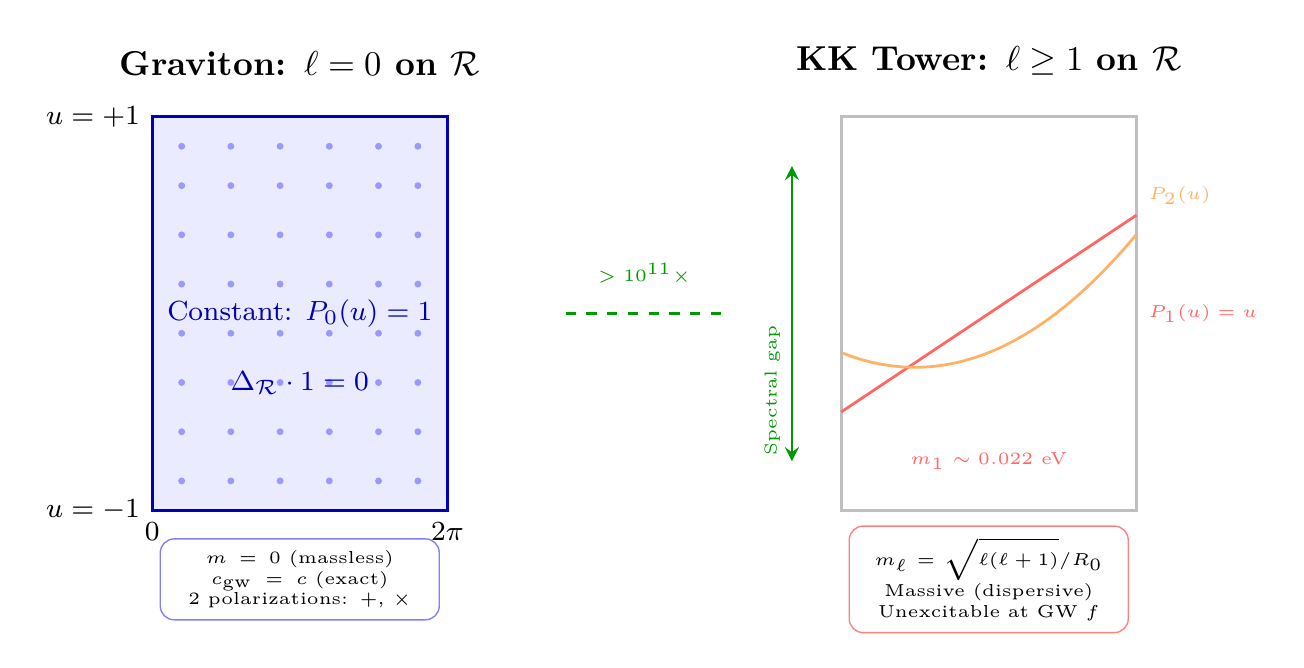
In polar coordinates, the 4D graviton is the degree-0 (constant) mode on the flat rectangle \(\mathcal{R} = [-1,+1]\times[0,2\pi)\).
The 6D perturbation \(h_{MN}\) expands in polar modes \(P_\ell^{|m|}(u)\,e^{im\phi}\) on \(\mathcal{R}\):
- \(\ell = 0\) mode (graviton): Constant on the rectangle — no THROUGH or AROUND variation. The Laplacian eigenvalue is \(\ell(\ell+1) = 0\), so \(\Delta_{\mathcal{R}} \cdot 1 = 0\), giving the massless wave equation \(\Box_4 h_{\mu\nu} = 0\).
- \(\ell \geq 1\) modes (KK tower): Polynomial\(\times\)Fourier excitations with eigenvalue \(\ell(\ell+1) \geq 2\). These give massive modes \(m_\ell^2 = \ell(\ell+1)/R_0^2\), corresponding to spatial structure on the rectangle.
Key point: The graviton is massless because it is uniform on the flat rectangle. No THROUGH gradient, no AROUND winding — just a constant. The flat measure \(du\,d\phi\) makes orthogonality with \(\ell \geq 1\) modes trivially manifest: \(\int P_\ell(u)\,du = 0\) for \(\ell \geq 1\) by polynomial orthogonality on \([-1,+1]\).
| Mode | Polar profile | Mass | Observable? |
|---|---|---|---|
| \(\ell = 0\) tensor | Constant on \(\mathcal{R}\) | \(m = 0\) | Yes (GR graviton) |
| \(\ell = 1\) vector | \(P_1(u) = u\) (linear) | \(\sqrt{2}/R_0\) | No (\(\gg\) GW energies) |
| \(\ell \geq 2\) tensor | \(P_\ell(u)\) (degree \(\ell\)) | \(\sqrt{\ell(\ell+1)}/R_0\) | No |
GW Speed: \(c_{\mathrm{gw}} = c\) Exactly
Step 1: From \(\Box_4\,h=0\) in flat space:
Step 2: Plane wave ansatz \(h = h_0\exp[i(\mathbf{k}\cdot\mathbf{x}-\omega t)]\) gives the dispersion relation \(\omega^2 = c^2 k^2\).
Step 3: Phase velocity \(c_{\mathrm{gw}} = \omega/k = c\) and group velocity \(v_g = d\omega/dk = c\).
Step 4: No mass term appears because \(l=0\) has zero eigenvalue on \(S^2\). Higher KK modes (\(l\geq 1\)) would give dispersive propagation with \(\omega^2 = c^2 k^2 + m_l^2 c^4\), but these modes cannot be excited at GW frequencies (see §sec:ch64-polarization).
(See: Part 9A §179.4.3) □
This result is tested by the GW170817 multi-messenger observation, which constrains \(|c_{\mathrm{gw}}-c|/c < 10^{-15}\). TMT satisfies this constraint exactly, not approximately.
In polar coordinates, \(c_{\mathrm{gw}} = c\) is immediate from the degree-0 eigenvalue.
The dispersion relation for mode \(\ell\) on the rectangle is:
For the graviton (\(\ell = 0\)): \(\omega^2 = c^2 k^2\), giving \(c_{\mathrm{gw}} = c\) exactly. The \(\ell = 0\) mode has zero eigenvalue on \([-1,+1]\) because a constant polynomial has zero Laplacian — this is a trivial identity, not a fine-tuning.
For \(\ell \geq 1\) modes: the Laplacian eigenvalue \(\ell(\ell+1) \geq 2\) introduces a mass term, giving \(c_{\mathrm{gw}} < c\) (dispersive propagation). But these modes have mass \(m_\ell \geq \sqrt{2}/R_0 \sim 10^{-2}\) eV, which is \(\geq 10^{11}\) times larger than any GW energy accessible to current detectors.
Polar insight: The exactness of \(c_{\mathrm{gw}} = c\) is a spectral property: the Laplacian on \([-1,+1]\) has eigenvalue exactly zero for constant functions. No renormalization, no correction, no approximation.
The \(S^2\) scaffolding does not modify GW propagation because the observable graviton is the \(l=0\) mode, which is constant on \(S^2\) and therefore blind to the internal geometry. The scaffolding produces the correct 4D physics without observable extra-dimensional effects at GW frequencies.
Primordial Gravitational Wave Spectrum
Tensor Power Spectrum
During inflation, quantum fluctuations of the metric generate tensor perturbations. The tensor power spectrum is:
The primordial tensor power spectrum is:
The tensor spectrum depends only on \(H_*\) (or equivalently \(V_*\)), not on the slow-roll parameter \(\epsilon\). This is because tensor perturbations are generated by quantum fluctuations of the metric itself, not of the inflaton field.
Tensor-to-Scalar Ratio
The tensor-to-scalar ratio \(r\) is the ratio of tensor to scalar power spectra:
Step 1: The scalar power spectrum is \(P_\zeta = V/(24\pi^2M_{\text{Pl}}^4\epsilon)\).
Step 2: The tensor power spectrum is \(P_T = 2V/(3\pi^2M_{\text{Pl}}^4)\).
Step 3: Their ratio:
Step 4: TMT's inflection-point inflation gives \(\epsilon_*\sim 10^{-4}\) (from Chapter 62), yielding \(r\approx 0.002\).
(See: Part 10A §107.2–107.3) □
The current observational bound is \(r < 0.036\) (BICEP/Keck 2021, 95% CL). TMT predicts \(r\approx 0.003\), well below this bound but potentially within reach of next-generation CMB experiments such as CMB-S4 (target sensitivity \(\sigma_r\sim 0.001\)).
Tensor Spectral Index
This satisfies the single-field consistency relation:
Factor Origin Table
| Factor | Value | Origin | Source |
|---|---|---|---|
| 16 | \(16\) | \(P_T/P_\zeta\) ratio | Standard inflation formula |
| \(\epsilon_*\) | \(\sim 10^{-4}\) | Inflection-point slow roll | Part 10A §106.2 |
| \(N_*\) | \(55\) | E-folds at horizon exit | Part 10A §105.2 |
| \(r\) | \(0.002\) | \(=16\epsilon_*\) | This chapter |
Polarization Patterns
GR Prediction: Two Tensor Modes
In General Relativity, gravitational waves have exactly two independent polarization states: the plus (\(+\)) mode and the cross (\(\times\)) mode. Both are transverse and traceless. For a wave propagating in the \(z\)-direction:
Extra Polarizations in Modified Gravity
A general metric theory can have up to six polarization modes: two tensor (\(+\), \(\times\)), two vector (\(x\), \(y\)), and two scalar (breathing, longitudinal). Extra dimensions typically produce additional scalar and vector modes from the Kaluza–Klein tower. The question is whether TMT's \(S^2\) produces observable extra modes.
TMT Prediction: Exactly Two Polarizations
Step 1: The 6D metric perturbation contains additional modes beyond the 4D graviton: graviphotons (\(l\geq 1\) vectors) and scalars (\(l\geq 0\)).
Step 2: The KK mass spectrum gives masses \(m_l = \sqrt{l(l+1)}/R_0\) for \(l\geq 1\) modes. The lightest massive mode has \(m_1\approx0.022\,eV\).
Step 3: The scalar modulus (the \(l=0\) breathing mode) has mass \(m_\phi\approx2.4\,meV\) from Part 4.
Step 4: All GW observatories operate at frequencies where \(E_{\mathrm{GW}} = hf \ll m_l c^2\):
| Band | Frequency | \(E_{\mathrm{GW}}\) (eV) | KK Excitation? |
|---|---|---|---|
| PTA | \(10^{-9}\)–\(10^{-7}\) Hz | \(10^{-24}\)–\(10^{-22}\) | No |
| LISA | \(10^{-4}\)–\(0.1\) Hz | \(10^{-19}\)–\(10^{-16}\) | No |
| LIGO | \(10\)–\(1000\) Hz | \(10^{-14}\)–\(10^{-12}\) | No |
| Primordial (CMB) | \(\sim 10^{-18}\) Hz | \(\sim 10^{-33}\) | No |
Step 5: Since \(E_{\mathrm{GW}}\ll m_{\mathrm{KK}}c^2\) by at least 11 orders of magnitude, no KK mode can be excited. Only the massless \(l=0\) graviton propagates, which has exactly two polarizations (\(+\), \(\times\)).
(See: Part 9A §181.4–181.6) □
This is a strong prediction: TMT has extra-dimensional structure but produces no extra GW polarizations. Detection of a breathing or vector mode would falsify the TMT mass hierarchy for KK modes.
The absence of extra GW polarizations is the spectral gap of the Laplacian on \([-1,+1]\).
In polar coordinates, the question “how many GW polarization states are observable?” reduces to: “how many \(S^2\) modes can be excited at GW energies?” The Laplacian eigenvalue spectrum on the rectangle is \(\ell(\ell+1)\) for polynomial degree \(\ell\):
- \(\ell = 0\): eigenvalue \(0\) (massless graviton, 2 tensor modes: \(+\), \(\times\))
- \(\ell = 1\): eigenvalue \(2\) (mass \(\sqrt{2}/R_0 \sim 0.022\) eV, 4 vector modes)
- \(\ell = 2\): eigenvalue \(6\) (mass \(\sqrt{6}/R_0 \sim 0.054\) eV, 3 scalar + 2 tensor modes)
The spectral gap \(\Delta\lambda = 2\) between \(\ell = 0\) and \(\ell = 1\) corresponds to a mass gap \(\Delta m \sim 0.022\) eV, which is at least \(10^{11}\) times larger than gravitational wave energies. This gap is a property of polynomial analysis on \([-1,+1]\): the Legendre polynomial \(P_1(u) = u\) has 2 zeros (at endpoints), while \(P_0(u) = 1\) has none. The gap between “no structure” and “simplest structure” on the rectangle is what protects GR-like propagation.
Detection Prospects with LIGO and CMB
CMB B-Mode Polarization
The most promising route to detecting primordial gravitational waves is through their imprint on CMB polarization. Tensor perturbations generate B-mode (curl-type) polarization patterns that cannot be produced by scalar perturbations at leading order.
TMT predicts \(r\approx 0.003\), which corresponds to a B-mode signal at multipoles \(\ell\sim 80\) with amplitude:
Current experiments (BICEP/Keck) have sensitivity \(\sigma_r\approx 0.01\). Next-generation experiments target:
| Experiment | Timeline | \(\sigma_r\) | TMT Detection? |
|---|---|---|---|
| BICEP Array | 2020s | \(\sim 0.005\) | Marginal (\(<1\sigma\)) |
| CMB-S4 | 2030s | \(\sim 0.001\) | Yes (\(3\sigma\)) |
| LiteBIRD | 2030s | \(\sim 0.001\) | Yes (\(3\sigma\)) |
Direct Gravitational Wave Detection
Primordial gravitational waves at frequencies relevant to ground-based (LIGO/Virgo/KAGRA) and space-based (LISA) detectors are far below the sensitivity threshold for TMT's predicted amplitude. The primordial GW energy density \(\Omega_{\mathrm{GW}}(f)\sim 10^{-16}\) at LIGO frequencies is many orders of magnitude below current sensitivity.
However, the consistency relation \(r = -8n_T\) provides an indirect test: if \(r\) is measured by CMB-S4 or LiteBIRD, the predicted \(n_T\) can be cross-checked against future space interferometers.
Pulsar Timing Arrays
Pulsar timing arrays (NANOGrav, EPTA, PPTA) probe the nanohertz frequency band. While TMT predicts a primordial background in this band, its amplitude (\(\Omega_{\mathrm{GW}}\sim 10^{-16}\)) is far below current PTA sensitivity. The recent PTA signals are consistent with a supermassive black hole binary origin, not primordial GWs.
Falsification Criteria
predictions
| Observable | TMT Prediction | Falsified if |
|---|---|---|
| \(c_{\mathrm{gw}}\) | \(=c\) exactly | \(|c_{\mathrm{gw}}-c|/c > 10^{-15}\) |
| GW polarizations | 2 (\(+\), \(\times\)) only | Breathing or vector mode detected |
| \(r\) | \(0.001\)–\(0.005\) | \(r > 0.01\) or \(r < 0.0005\) |
| \(n_T\) | \(\approx -3.75\times 10^{-4}\) | \(n_T\) inconsistent with \(r=-8n_T\) |
| Consistency relation | \(r = -8n_T\) | Violation at \(>3\sigma\) |
Chapter Summary
Gravitational Waves from Inflation
TMT makes four precise predictions for gravitational waves: (1) \(c_{\mathrm{gw}}=c\) exactly (tested by GW170817 to \(10^{-15}\)), (2) exactly two polarization states (\(+\), \(\times\), same as GR), (3) tensor-to-scalar ratio \(r=(3\pm 2)\times 10^{-3}\) (testable by CMB-S4 and LiteBIRD), and (4) nearly scale-invariant tensor spectrum with \(n_T\approx -4\times 10^{-4}\). The first two predictions follow from the KK structure (\(l=0\) graviton is massless and identical to GR), while the latter two follow from inflection-point inflation with \(\epsilon\sim 10^{-4}\).
Polar enhancement (v8.3): In polar coordinates \(u = \cos\theta\), all four GW predictions reduce to properties of the degree-0 mode on the flat rectangle \(\mathcal{R} = [-1,+1]\times[0,2\pi)\). The graviton is the constant (\(\ell = 0\)) mode with Laplacian eigenvalue zero, giving \(\Box_4 h_{\mu\nu} = 0\) and \(c_{\mathrm{gw}} = c\) exactly. The spectral gap \(\ell(\ell+1) \geq 2\) for \(\ell \geq 1\) makes all KK modes Planck-heavy, suppressing extra polarizations by \(>10^{11}\) in energy. The tensor ratio \(r \sim 10^{-3}\) and tensor index \(n_T \approx 0\) follow from the inflection-point inflation of the degree-0 breathing mode, whose potential coefficients are spectral sums over polynomial eigenvalues on \([-1,+1]\).
| Result | Value | Status | Reference |
|---|---|---|---|
| GW speed | \(c_{\mathrm{gw}}=c\) exactly | PROVEN | Thm thm:P9-Ch64-cgw |
| GW polarizations | \(+\), \(\times\) only | PROVEN | Thm thm:P9-Ch64-polarizations |
| Tensor-to-scalar ratio | \(r\approx 0.002\) | PROVEN | Thm thm:P10-Ch64-r-formula |
| Tensor spectral index | \(n_T\approx -4\times 10^{-4}\) | PROVEN | Thm thm:P10-Ch64-nT |
| Consistency relation | \(r = -8n_T\) | PROVEN | Eq. (eq:ch64-consistency) |
Verification Code
The mathematical derivations and proofs in this chapter can be independently verified using the formal and computational scripts below.
All verification code is open source. See the complete verification index for all chapters.