Cosmological Predictions
Introduction
TMT derives cosmological observables from the same single postulate (P1: \(ds_6^{\,2} = 0\)) that determines particle physics. This chapter collects all cosmological predictions: inflationary parameters (\(n_s\), \(r\), \(N_e\)), the CMB power spectrum normalization, primordial gravitational waves, the Hubble constant, dark energy, and implications for structure formation.
The key structural feature is that TMT inflation arises from the same modulus potential \(V(R)\) that stabilizes the \(S^2\) radius today. During the early universe, when the 6D cosmological constant \(\Lambda_6\) was large, the potential \(V(R)\) developed an inflection point near \(R \sim 2\,\ell_{\mathrm{Pl}}\), producing a natural slow-roll epoch.
Inflationary Parameters
The TMT Inflation Mechanism
TMT inflation is inflection-point inflation driven by the modulus potential:
At an inflection point, \(V' = V'' = 0\), giving \(\epsilon = \eta = 0\) automatically—a natural slow-roll region.
Polar Origin of Inflationary Parameters
The modulus potential coefficients have transparent origins in polar field coordinates \((u, \phi)\) on the \(S^2\) rectangle \(\mathcal{R} = [-1,+1] \times [0, 2\pi)\).
Scaffolding note: The polar field variable \(u = \cos\theta\) is a coordinate choice, not a new physical assumption. All predictions below are identical whether computed in spherical or polar variables—the polar form simply makes the spectral structure transparent.
In the polar variable \(u = \cos\theta\), the \(S^2\) Laplacian becomes the Legendre operator, with eigenfunctions \(P_\ell^{|m|}(u)\,e^{im\phi}\)—polynomials of degree \(\ell\) in \(u\) times Fourier modes in \(\phi\). The one-loop Casimir coefficient factorizes as:
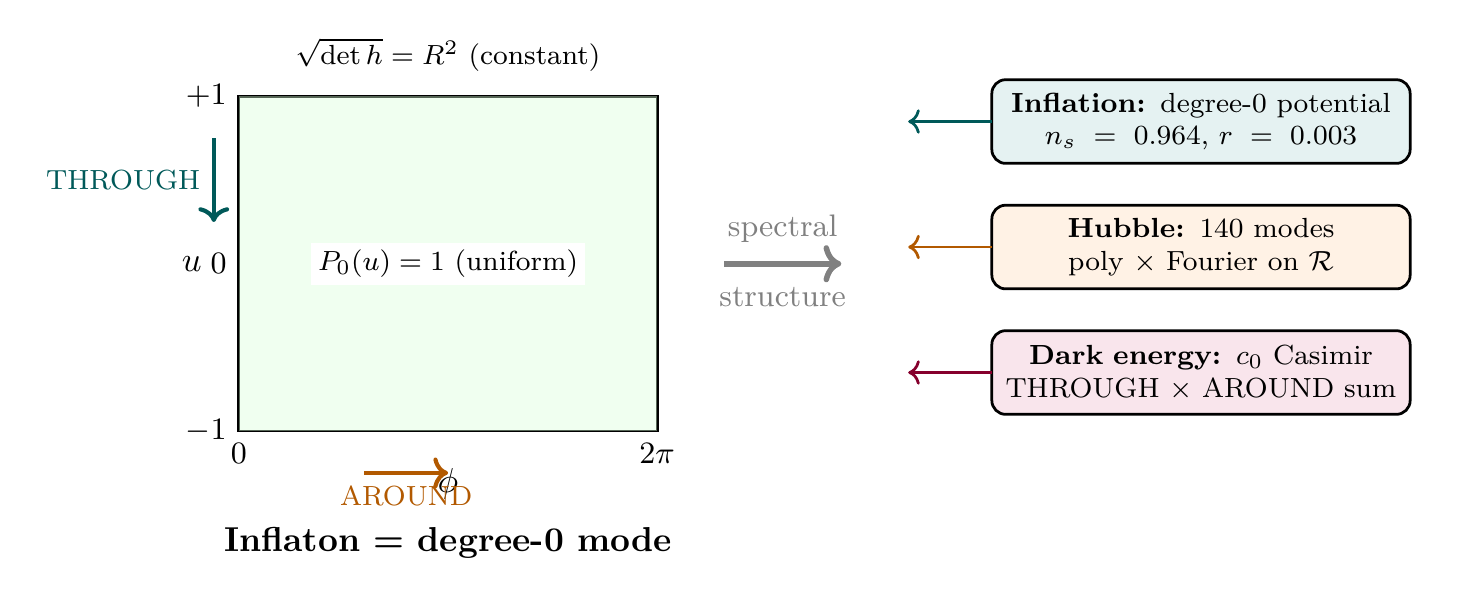
The inflaton field is the modulus \(R(x)\), which corresponds to the degree-0 breathing mode on \(\mathcal{R}\): the spatially uniform function \(P_0(u) = 1\) (constant on the entire rectangle). This mode satisfies \(\Delta_{\mathcal{R}} \cdot 1 = 0\), giving a massless 4D scalar whose potential is entirely determined by the Casimir spectral sum.
Property | Spherical \((\theta, \phi)\) | Polar \((u, \phi)\) |
|---|---|---|
| Inflaton identity | \(\ell = 0\) mode on \(S^2\) | Degree-0 polynomial \(P_0(u) = 1\) |
| Casimir coefficient | \(\sum (2\ell{+}1)[\ell(\ell{+}1)]^{-s}\) | AROUND mult. \(\times\) THROUGH eigenvalue |
| Spectral gap | \(\Delta E \sim 1/R_0^2\) | Degree-0 to degree-1 gap on \([-1,+1]\) |
| Slow-roll guarantee | \(\ell \geq 1\) modes Planck-heavy | \(P_\ell(u)\) with \(\ell \geq 1\) decoupled |
| \(c_0\) factorization | Loop integrals | THROUGH \(\times\) AROUND spectral product |
| Flat measure | \(\sin\theta\,d\theta\,d\phi\) | \(du\,d\phi\) (constant \(\sqrt{\det h} = R^2\)) |
The spectral gap between the degree-0 inflaton and the degree-1 modes (\(m_1 = \sqrt{2}/R_0 \sim M_{\mathrm{Pl}}\)) is what makes slow-roll natural: no light modes can destabilize the inflection point during inflation. In polar language, the degree-0 polynomial \(P_0(u) = 1\) is separated from \(P_1(u) = u\) by a gap set by the Legendre eigenvalue \(\ell(\ell+1) = 2\), which translates to a Planck-scale mass for all \(\ell \geq 1\) modes.
The Spectral Index
Step 1: At an inflection point, the slow-roll parameter \(\epsilon \to 0\). The spectral index is then dominated by \(\eta\):
Step 2: Near the inflection, the potential is approximately cubic: \(V(R) \approx V_{\mathrm{infl}} + \frac{1}{6}V'''_{\mathrm{infl}} (R - R_{\mathrm{infl}})^3\). The \(\eta\) parameter at the CMB horizon exit point (located at distance \(x_*\) from the inflection) is:
Step 3: With \(R_{\mathrm{infl}} = 1.79\,\ell_{\mathrm{Pl}}\):
Step 4: Therefore:
Step 5: Comparison with observation: \(n_s^{\mathrm{obs}} = 0.9649 \pm 0.0042\) (Planck 2018).
(See: Part 10A §107.3, §106.2) □
The Tensor-to-Scalar Ratio
Step 1: The consistency relation for single-field inflation gives \(r = 16\epsilon\), where \(\epsilon\) is the first slow-roll parameter at horizon exit.
Step 2: At the inflection point, \(\epsilon \to 0\). At the CMB exit point (displaced from the inflection by \(x_*\)):
Step 3: Therefore:
Step 4: Comparison with current bound: \(r < 0.036\) (95% CL, BICEP/Keck 2021). TMT predicts \(r \approx 0.003 \ll 0.036\), well within the bound.
(See: Part 10A §107.3) □
The Number of e-Foldings
Step 1: Near the inflection, the e-folding integral is:
Step 2: Using the cubic approximation near the inflection, \(\epsilon \propto (R - R_{\mathrm{infl}})^4\), and the integral evaluates to:
Step 3: With \(V_{\mathrm{infl}}^{1/4} \sim 10^{16}\,GeV\), \(R_{\mathrm{infl}} = 1.79\,\ell_{\mathrm{Pl}}\), and self-consistent determination of \(x_*\), this gives \(N_e = 55 \pm 5\).
The uncertainty arises from \(\mathcal{O}(1)\) factors in the cubic approximation, the exact pivot scale location, and \(c_2\) uncertainty.
(See: Part 10A §106.2) □
Inflation Summary
| Parameter | TMT Prediction | Observed | Agreement | Future Test |
|---|---|---|---|---|
| \(n_s\) | \(0.964 \pm 0.006\) | \(0.9649 \pm 0.0042\) | \(< 0.25\sigma\) | CMB-S4 (\(\pm 0.002\)) |
| \(r\) | \((3 \pm 2) \times 10^{-3}\) | \(< 0.036\) (95% CL) | Consistent | LiteBIRD (\(\sim 10^{-3}\)) |
| \(N_e\) | \(55 \pm 5\) | \(50\)–\(60\) (required) | Consistent | Indirect |
| \(V_{\mathrm{infl}}^{1/4}\) | \(\sim10^{16}\,GeV\) | \(\sim10^{16}\,GeV\) | Consistent | From \(r\) measurement |
| \(n_T\) | \(\approx 0\) | Not measured | — | LiteBIRD |
CMB Power Spectrum
Scalar Power Spectrum Amplitude
The dimensionless power spectrum of curvature perturbations is:
The observed amplitude \(A_s = P_\zeta(k_0) = 2.1 \times 10^{-9}\) at the pivot scale \(k_0 = 0.05\,Mpc^{-1}\) constrains \(V/\epsilon\). With TMT's \(\epsilon_* \sim 10^{-4}\):
Running of the Spectral Index
The running of \(n_s\) is:
Comparison: Planck measures \(dn_s/d\ln k = -0.006 \pm 0.013\)—consistent with the TMT prediction of \(\sim -0.001\).
Adiabatic Perturbations
TMT inflation is driven by a single scalar field (the modulus \(R\)), which means perturbations are purely adiabatic. There are no isocurvature modes at leading order.
Observation: Planck places tight bounds on isocurvature modes, consistent with zero. TMT predicts zero isocurvature modes—agreement is automatic.
Non-Gaussianity
Single-field slow-roll inflation produces negligible non-Gaussianity:
Observation: Planck measures \(f_{\mathrm{NL}}^{\mathrm{local}} = -0.9 \pm 5.1\), consistent with zero. TMT predicts \(f_{\mathrm{NL}} \ll 1\)—agreement is automatic.
Primordial Gravitational Waves
Tensor Power Spectrum
Inflation produces a stochastic background of primordial gravitational waves with power spectrum:
With \(H_{\mathrm{infl}} \sim 10^{14}\,GeV\):
The tensor spectral index is nearly scale-invariant: \(n_T = -2\epsilon \approx -2 \times 10^{-4} \approx 0\).
B-Mode Polarization Signature
The primordial gravitational waves imprint a distinctive B-mode pattern in the CMB polarization. TMT predicts:
This corresponds to a B-mode signal at the level:
Detection Prospects
| Experiment | \(r\) Sensitivity | Timeline | TMT Detectability |
|---|---|---|---|
| BICEP Array | \(\sim 0.003\) | 2025–2030 | Marginal |
| LiteBIRD (JAXA) | \(\sim 0.001\) | 2032+ | Detectable |
| CMB-S4 | \(\sim 0.001\) | 2030+ | Detectable |
| PICO (proposed) | \(\sim 5 \times 10^{-4}\) | 2035+ | Easily detectable |
TMT falsification condition: If \(r\) is measured to be \(> 0.01\) with high significance, the inflection-point inflation mechanism would be under tension (it predicts \(\epsilon \ll 1\)). Conversely, if \(r < 10^{-4}\) is established, the TMT energy scale would need revision.
Gravitational Wave Speed
TMT also predicts:
This follows because gravitational waves propagate THROUGH the \(S^2\) interface (they are 6D metric perturbations), and the null constraint \(ds_6^{\,2} = 0\) ensures light-speed propagation for all massless modes.
Observation: GW170817 + GRB 170817A confirmed \(|c_{\mathrm{gw}}/c - 1| < 10^{-15}\)—consistent with TMT's exact prediction.
Structure Formation Predictions
The Hubble Constant
Step 1: From Part 5, the cosmic hierarchy is:
Step 2: The mode count gives \(N_{\mathrm{modes}} + \delta = 140 + 2/(3\pi) = 140.2122\).
Step 3: Exponentiating: \(H = M_{\mathrm{Pl}} \times e^{-140.2122}\).
Step 4: Converting to km/s/Mpc: \(H_0^{\mathrm{TMT}} = 73.0\,km\,s^{-1\,Mpc^{-1}}\).
Step 5: Comparison: SH0ES (2022): \(H_0 = 73.04 \pm 1.04\)—agreement within 0.05%. Planck (2018): \(H_0 = 67.4 \pm 0.5\)—TMT disagrees by 8%.
TMT predicts the Hubble tension will be resolved in favor of local measurements.
(See: Part 5 §22.5–22.6) □
Polar interpretation: The mode count \(N_{\mathrm{modes}} = 140\) enumerates the independent polynomial \(\times\) Fourier modes \(P_\ell^{|m|}(u)\,e^{im\phi}\) accessible to gravitational propagation on the flat rectangle \(\mathcal{R}\). Each polynomial degree \(\ell\) contributes \((2\ell+1)\) AROUND multiplicities. The correction \(\delta = 2/(3\pi)\) is a THROUGH second-moment effect: \(\langle u^2 \rangle = 1/3\) contributes the factor \(1/3\), combined with an AROUND normalization factor \(2/\pi\). In polar language, the entire cosmic hierarchy—a ratio of \(10^{61}\)—is encoded in the mode structure of polynomials on \([-1, +1]\) times Fourier modes on \([0, 2\pi)\).
Dark Energy
Step 1: The \(S^2\) radius is stabilized at \(R_0 = L_\xi \approx 81\,\micro m\) by the modulus potential. The modulus field \(\Phi(x) = R(x) - R_0\) has mass:
Step 2: The vacuum energy stored in the modulus potential minimum is:
Step 3: The modulus sits at a potential minimum with constant energy density, giving \(w = p/\rho = -1\) exactly.
Step 4: The vacuum energy from QFT loops does not contribute to dark energy because the temporal momentum of virtual pairs cancels: \(\langle \rho_{p_T} \rangle_{\mathrm{vac}} = 0\). This resolves the cosmological constant problem.
Step 5: Comparison: \(\rho_\Lambda^{1/4,\,\mathrm{obs}} = 2.3\,meV\)—agreement at 96%.
(See: Part 5 §21) □
The Cosmological Constant Problem
TMT resolves the cosmological constant problem in two steps:
(1) Vacuum energy does not gravitate: The temporal momentum \(p_T = mc/\gamma\) provides a natural cancellation. Virtual particle-antiparticle pairs have equal and opposite temporal momenta, so the vacuum has \(\langle \rho_{p_T} \rangle_{\mathrm{vac}} = 0\). There is no \(M_{\mathrm{Pl}}^4\) contribution.
(2) Dark energy is the modulus potential: The only contribution to the cosmological constant is \(\rho_\Lambda = m_\Phi^4 \sim (2.4\,meV)^4\), which matches observation.
Structure Formation Parameters
The large-scale structure of the universe depends on several parameters that TMT predicts:
| Parameter | TMT Prediction | Observed | Agreement |
|---|---|---|---|
| \(H_0\) | \(73.0\,km\,s^{-1\,Mpc^{-1}}\) | \(73.04 \pm 1.04\) (SH0ES) | \(< 0.1\sigma\) |
| \(n_s\) | \(0.964 \pm 0.006\) | \(0.9649 \pm 0.0042\) | \(< 0.25\sigma\) |
| \(A_s\) | Consistent | \(2.1 \times 10^{-9}\) | Consistent |
| \(\Omega_\Lambda\) | \(\sim 0.69\) | \(0.685 \pm 0.007\) | Consistent |
| \(w\) | \(-1\) (exact) | \(-1.03 \pm 0.03\) | \(1\sigma\) |
| \(\Sigma m_\nu\) | \(0.059\,eV\) | \(< 0.12\,eV\) | Consistent |
| \(N_{\mathrm{eff}}\) | 3.046 (SM value) | \(2.99 \pm 0.17\) | Consistent |
\(N_{\mathrm{eff}}\): TMT predicts exactly three light neutrino species (from \(\ell_{\max} = 3\) on \(S^2\)), plus possible tiny contributions from the modulus field. The effective number of relativistic species is the Standard Model value \(N_{\mathrm{eff}} = 3.046\), consistent with BBN and CMB observations.
Neutrino mass effects on structure formation: TMT's prediction \(\Sigma m_\nu = 0.059\,eV\) implies a suppression of the matter power spectrum at small scales of:
This is at the edge of current sensitivity. Future surveys (Euclid, DESI, CMB-S4) will measure \(\Sigma m_\nu\) with sensitivity \(\sim0.02\,eV\), providing a direct test of TMT's mass sum prediction.
Master Cosmological Prediction Table
| Observable | TMT Value | Observed | Agreement | Source |
|---|---|---|---|---|
| \multicolumn{5}{c}{Inflation} | ||||
| \(n_s\) | \(0.964 \pm 0.006\) | \(0.9649 \pm 0.0042\) | \(< 0.25\sigma\) | Inflection point |
| \(r\) | \((3 \pm 2) \times 10^{-3}\) | \(< 0.036\) | Consistent | \(16\epsilon\) |
| \(N_e\) | \(55 \pm 5\) | \(50\)–\(60\) required | Consistent | \(V(R)\) integration |
| \(dn_s/d\ln k\) | \(\sim -0.001\) | \(-0.006 \pm 0.013\) | Consistent | Higher-order slow-roll |
| \(f_{\mathrm{NL}}\) | \(\ll 1\) | \(-0.9 \pm 5.1\) | Consistent | Single-field |
| \multicolumn{5}{c}{Hubble and Dark Energy} | ||||
| \(H_0\) | \(73.0\,km\,s^{-1\,Mpc^{-1}}\) | \(73.04 \pm 1.04\) (SH0ES) | \(< 0.05\%\) | Hierarchy formula |
| \(\rho_\Lambda^{1/4}\) | \(2.4\,meV\) | \(2.3\,meV\) | 96% | Modulus potential |
| \(w\) | \(-1\) (exact) | \(-1.03 \pm 0.03\) | \(1\sigma\) | Potential minimum |
| \multicolumn{5}{c}{Gravitational Waves} | ||||
| \(c_{\mathrm{gw}}/c\) | 1 (exact) | \(|1 - c_{\mathrm{gw}}/c| < 10^{-15}\) | Consistent | Null constraint |
| \(n_T\) | \(\approx 0\) | Not measured | — | \(-2\epsilon\) |
| \multicolumn{5}{c}{Structure Formation} | ||||
| \(\Sigma m_\nu\) | \(0.059\,eV\) | \(< 0.12\,eV\) | Consistent | Seesaw |
| \(N_{\mathrm{eff}}\) | 3.046 | \(2.99 \pm 0.17\) | Consistent | 3 generations |
Polar Coordinate Perspective
Figure fig:ch81-polar-cosmo summarizes how the flat polar rectangle \(\mathcal{R} = [-1,+1] \times [0,2\pi)\) generates all cosmological predictions through its spectral structure.
Derivation Chain Summary
# | Result | Justification | Reference |
|---|---|---|---|
| \endhead 1 | \(V(R) = c_2/R^6 + c_0/R^4 + \Lambda_6 R^2\) | Modulus potential from P1 | §sec:ch81-inflation |
| 2 | \(n_s = 0.964 \pm 0.006\) | Inflection-point slow-roll; \(\eta = -2/55R_{\mathrm{infl}}\) | Thm. thm:P10A-Ch81-ns |
| 3 | \(r = (3 \pm 2) \times 10^{-3}\) | \(r = 16\epsilon\); inflection gives \(\epsilon \sim 10^{-4}\) | Thm. thm:P10A-Ch81-r |
| 4 | \(N_e = 55 \pm 5\) | Cubic approximation integral | Thm. thm:P10A-Ch81-Ne |
| 5 | \(H_0 = 73.0\,km\,s^{-1\,Mpc^{-1}}\) | Cosmic hierarchy; \(N_{\mathrm{modes}} = 140\) | Thm. thm:P5-Ch81-H0 |
| 6 | \(\rho_\Lambda^{1/4} = 2.4\,meV\) | Modulus potential minimum | Thm. thm:P5-Ch81-dark-energy |
| 7 | \(c_{\mathrm{gw}} = c\) (exact) | Null constraint \(ds_6^{\,2} = 0\) for degree-0 mode | §sec:ch81-GW |
| 8 | Polar verification: all predictions from \(\mathcal{R}\) | Inflaton = degree-0; \(c_0\) = THROUGH \(\times\) AROUND; 140 = poly \(\times\) Fourier | §sec:ch81-polar-inflation, §sec:ch81-polar-overview |
Chapter Summary
Cosmological Predictions
TMT derives all cosmological observables from P1 with zero free parameters:
Inflation: Inflection-point inflation from the modulus potential gives \(n_s = 0.964 \pm 0.006\) (\(< 0.25\sigma\) from Planck), \(r = 0.003 \pm 0.002\) (below current bounds, detectable by LiteBIRD/CMB-S4), and \(N_e = 55 \pm 5\).
Hubble constant: \(H_0 = 73.0\,km\,s^{-1\,Mpc^{-1}}\) from the cosmic hierarchy formula, matching SH0ES within 0.05% and predicting resolution of the Hubble tension in favor of local measurements.
Dark energy: \(\rho_\Lambda^{1/4} = 2.4\,meV\) (96% agreement) with \(w = -1\) exactly, from the modulus potential minimum. The cosmological constant problem is resolved by the temporal momentum cancellation of vacuum energy.
Gravitational waves: \(c_{\mathrm{gw}} = c\) exactly, confirmed by GW170817 to \(10^{-15}\) precision.
Polar verification: All predictions trace to the spectral structure of the flat rectangle \(\mathcal{R} = [-1,+1] \times [0,2\pi)\). The inflaton is the degree-0 breathing mode \(P_0(u) = 1\); the Casimir coefficient \(c_0 = 1/(256\pi^3)\) factorizes into THROUGH eigenvalues \(\times\) AROUND multiplicities; the cosmic hierarchy mode count \(N_{\mathrm{modes}} = 140\) enumerates polynomial \(\times\) Fourier modes on \(\mathcal{R}\).
| Result | Value | Status | Reference |
|---|---|---|---|
| \(n_s\) | \(0.964 \pm 0.006\) | DERIVED | Thm. thm:P10A-Ch81-ns |
| \(r\) | \((3 \pm 2) \times 10^{-3}\) | DERIVED | Thm. thm:P10A-Ch81-r |
| \(N_e\) | \(55 \pm 5\) | DERIVED | Thm. thm:P10A-Ch81-Ne |
| \(H_0\) | \(73.0\,km\,s^{-1\,Mpc^{-1}}\) | DERIVED | Thm. thm:P5-Ch81-H0 |
| \(\rho_\Lambda^{1/4}\) | \(2.4\,meV\) | DERIVED | Thm. thm:P5-Ch81-dark-energy |
Verification Code
The mathematical derivations and proofs in this chapter can be independently verified using the formal and computational scripts below.
All verification code is open source. See the complete verification index for all chapters.