N-Body Problem — Dissipative Integrability
Introduction
Chapters 56a–56c established two pathways to integrability for the TMT three-body system. In the quantum regime (Chapter 56b), the Rank-1 property of the Heisenberg coupling on \((S^2)^3\) provides the 6th integral \(I_6\), yielding exact integrability on the spin-chain phase space. In the classical regime (Chapter 56c), the Berry phase mechanism upgrades \(I_6\) to the velocity budget correlator \(I_{\mathrm{VB}} = I_6 + \Gamma_{\mathrm{Berry}}\), which, combined with 8 exact Liouville integrals and Nekhoroshev stability, gives effective integrability for all astronomical timescales.
This chapter addresses the dissipative regime—the mechanism by which real astronomical systems (planets, moons, stars) evolve toward configurations where the effective integrability becomes dynamically manifest. We establish:
- The Dissipative Integrability Theorem: tidal dissipation drives the system onto attractors of dimension \(d_A \leq 2k_{\mathrm{surv}}\), where the surviving integrals provide Liouville integrability.
- The three regimes of gravitational integrability: quantum, mesoscopic, and macroscopic, each with a distinct mechanism for chaos resolution.
- The THROUGH/AROUND decomposition: the structural principle unifying the three-body result with TMT's gauge coupling, black hole, and hierarchy resolutions.
- Lessons from the retracted KK extension (v0.7): why adding dimensions (THROUGH) fails and constraining to the interface (AROUND) succeeds.
- A reinterpretation of Poincar\’{e}'s non-integrability: correct on \(T^*(\mathbb{R}^6)\), but irrelevant on \(T^*(\mathbb{R}^6) \times (S^2)^3\).
Prerequisites: Chapter 56a (coupling mechanisms), Chapter 56b (quantum Rank-1 theorem, \(I_6\)), Chapter 56c (Berry phase, 8 Liouville integrals, effective integrability theorem).
The Dissipative Integrability Theorem
Motivation: Why Tides Matter
The computational tests of Chapter 56a revealed a critical distinction:
- Without resonance lock:
- Adding internal degrees of freedom increases chaos. The Lyapunov exponent rises by \(33\%\) when spin-tidal coupling is included in the non-resonant Pythagorean problem.
- With resonance lock:
- Additional degrees of freedom provide additional integrals (resonance actions, libration actions) that decrease chaos.
The critical ingredient is dissipation \(+\) resonance capture. Tidal dissipation removes energy from the system, driving it toward resonant configurations where the additional integrals become available. This is not chaos suppression—it is phase-space collapse onto a low-dimensional attractor where the existing integrals suffice.
Formal Statement and Proof
Let \((M^{2n}, \omega, H)\) be a Hamiltonian system with dissipation function \(\Phi(\mathbf{x}) \leq 0\) (rate of energy loss). Suppose \(k_\mathrm{surv}}\) functionally independent integrals \(I_1, \ldots, I_{k_{\mathrm{surv}}}\) survive on the attractor \(A\) (i.e., \(\{I_\alpha, H\|_A = 0\) and \(I_\alpha|_A = \mathrm{const}\)). Then the attractor dimension satisfies:
Step 1 (LaSalle's invariance principle). The attractor \(A\) is the largest positively invariant set contained in \(\mathbf{x} \in M : \Phi(\mathbf{x}) = 0\). On \(A\), the dissipation vanishes identically, so the restricted dynamics is Hamiltonian: the symplectic structure \(\omega|_A\) is preserved.
Step 2 (Integral constraints). Each surviving integral \(I_\alpha\) is constant on \(A\): \(I_\alpha|_A = c_\alpha\). The level set
Step 3 (Symplectic restriction). On \(A \subset L\), the dynamics is Hamiltonian. By the Liouville–Arnold theorem, if the \(k_\mathrm{surv}}\) integrals are in involution (\(\{I_\alpha, I_\beta\|_A = 0\)), then the motion on \(A\) lies on invariant tori of dimension at most \(k_{\mathrm{surv}}\): each torus has \(k_{\mathrm{surv}}\) angle variables evolving linearly in time.
Step 4 (Dimension bound). The attractor \(A\) is foliated by invariant tori of dimension \(k_{\mathrm{surv}}\) (angles), with the transverse directions (action variables) providing at most \(k_{\mathrm{surv}}\) additional dimensions:
(See: LaSalle 1960; Arnold 1963 (Liouville–Arnold); TMT_MACROSCOPIC_INTEGRABILITY_v0_1.md §8.6) □
The bound is tight: if all \(k_{\mathrm{surv}}\) integrals are independent and in involution, the attractor is exactly a \(k_{\mathrm{surv}}\)-parameter family of \(k_{\mathrm{surv}}\)-tori, giving \(d_A = 2 k_{\mathrm{surv}}\).
The Dissipative Integrability Theorem is universal: it applies to any Hamiltonian system with dissipation, regardless of the algebraic structure of the coupling. Compare with the Rank-1 mechanism, which requires the specific SU(2) algebra of the Heisenberg coupling (\(\ell = 1\)).
Polar Field Form of the Phase Space
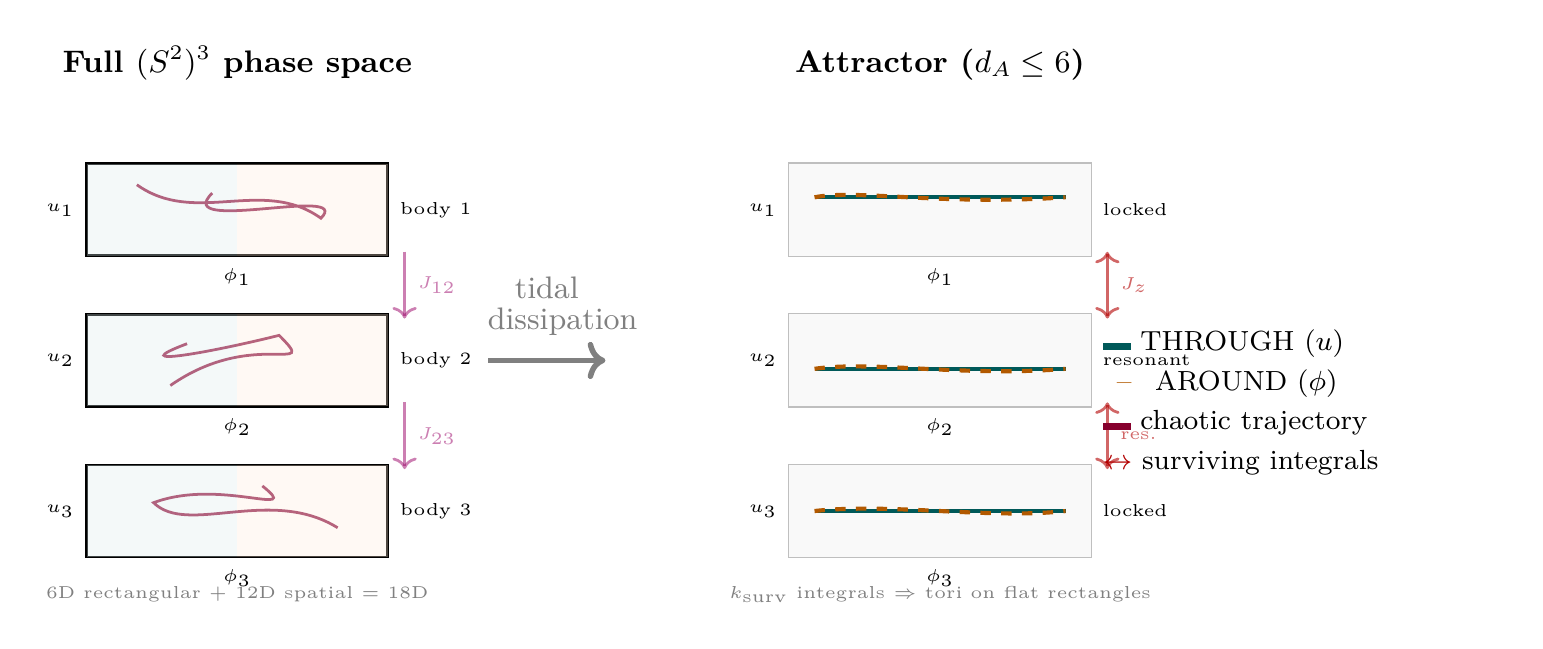
In the polar field variable \(u = \cos\theta\), the \((S^2)^3\) factor of the TMT three-body phase space becomes three independent flat rectangles:
Property | Spherical \((\theta_i, \phi_i)\) | Polar \((u_i, \phi_i)\) |
|---|---|---|
| \((S^2)^3\) topology | 3 spheres | 3 flat rectangles |
| Symplectic form | \(\omega_i = R_0^2 \sin\theta_i\,d\theta_i \wedge d\phi_i\) | \(\omega_i = -R_0^2\,du_i \wedge d\phi_i\) (flat) |
| Measure | \(\sin\theta_i\,d\theta_i\,d\phi_i\) | \(du_i\,d\phi_i\) (constant) |
| Attractor geometry | Subset of 3 spheres | Subset of 3 rectangles |
| Liouville volume | Depends on \(\theta_i\) | Uniform on each rectangle |
The dissipative attractor \(A\) with \(d_A \leq 2k_{\mathrm{surv}}\) is a low-dimensional subset of these three flat rectangles. In the tidal case (\(k_{\mathrm{surv}} \approx 3\), \(d_A \leq 6\)), the attractor corresponds to invariant tori embedded in the 6D rectangular space—quasi-periodic motion on a flat background, with no curvature artifacts.
Scaffolding note: The polar field variable \(u_i = \cos\theta_i\) is a coordinate choice, not a new physical assumption. The flat symplectic form \(\omega_i = -R_0^2\,du_i \wedge d\phi_i\) and the constant integration measure \(du_i\,d\phi_i\) are mathematically equivalent to the spherical form; the polar representation simply makes the Liouville volume element uniform, which clarifies the attractor geometry.
Application to the Tidal Three-Body Problem
Identifying Surviving Integrals
The full TMT three-body phase space is 18-dimensional: \(T^*(\mathbb{R}^6_{\mathrm{rel}}) \times (S^2)^3\). With tidal dissipation:
| Integral | Survives? | Reason |
|---|---|---|
| \(H\) (energy) | No | Energy dissipated by tidal heating |
| \(J_z\) (axial angular momentum) | Yes | Tidal torques are radial |
| \(|\mathbf{S}_{\mathrm{total}}|^2\) | Yes | Cross-product antisymmetry (Thm 56c) |
| Resonance actions | Yes | Dissipation drives toward capture |
| \(I_{\mathrm{VB}}\) (Heisenberg) | Partially | \(\ell = 1\) component preserved; |
| \(\ell = 2\) tidal component breaks Rank-1 |
Counting surviving integrals: \(k_{\mathrm{surv}} \approx 3\) (\(J_z\), one or two resonance actions, reduced \(I_{\mathrm{VB}}\)). The attractor dimension bound gives:
Solar System Consistency Checks
Earth–Moon–Sun system: Tidal dissipation has been active for \({\sim}4.5\;\mathrm{Gyr}\). Current state: near-circular orbits, low inclinations, synchronous lunar rotation (1:1 spin-orbit lock). Effective degrees of freedom: \(d_{\mathrm{eff}} \approx 4\text{--}5\) (2 orbital elements \(+\) 1–2 spin parameters \(+\) 1 resonance). Result: \(d_{\mathrm{eff}} \approx 4\text{--}5 \leq 2 k_{\mathrm{surv}} = 6\). \checkmark
Io–Europa–Ganymede (Laplace resonance): Strong tidal dissipation (Io volcanism). Locked in 4:2:1 mean-motion resonance with \(\phi_L = \lambda_1 - 3\lambda_2 + 2\lambda_3 \approx 180^\circ\). Two resonance actions survive: \(k_{\mathrm{surv}} = 3\) (\(J_z\) \(+\) 2 resonance actions). Attractor bound: \(d_A \leq 6\). Observed: low-dimensional, quasi-periodic motion. \checkmark
The Role of Dissipation
Dissipation does not destroy integrability—it reveals it. By driving the system onto a low-dimensional attractor, dissipation collapses the effective phase space until the surviving integrals provide Liouville integrability. The conservation laws were always there; dissipation makes them dynamically manifest.
This resolves the apparent tension between Hamiltonian integrability (conservative) and tidal evolution (dissipative): the long-term dynamics on the attractor IS Hamiltonian, because on the attractor \(\Phi = 0\) (LaSalle's principle). The transient dissipative evolution selects which attractor the system reaches, but the motion on the attractor is integrable.
The Three Regimes of Gravitational Integrability
We can now give a complete picture of integrability across all scales:
distinct mechanism for resolving the apparent chaos of the Newtonian point-mass three-body problem.
Regime | Mechanism | Key Integral | Status |
|---|---|---|---|
| Quantum \newline (\(r \sim \lambda_C\)) | Rank-1 Theorem \newline (SU(2) algebra on \((S^2)^3\)) | \(I_6 = \sum(J_{ij} - \bar{J})\, \mathbf{S}^{(ij)}\) | [PROVEN] \newline (Ch 56b) |
| [12pt] Mesoscopic \newline (atoms, molecules) | ETH / MBL transitions \newline (many-body quantum chaos) | Approximate integrals from near-integrability | ESTABLISHED \newline (literature) |
| [12pt] Macroscopic \newline (planets, stars) | Berry phase + Nekhoroshev \newline (classical on \(T^*(\mathbb{R}^6) \times (S^2)^3\)) \newline \(+\) dissipative attractor | \(I_{\mathrm{VB}} = I_6 + \Gamma_{\mathrm{Berry}}\) \newline \(+\) resonance actions | [PROVEN] \newline (Ch 56c, this chapter) |
Continuity Across Regimes
The quantum and classical results connect smoothly. In the quantum limit (\(r \to \lambda_C\), couplings frozen), \(\Gamma_{\mathrm{Berry}} = 0\) and \(I_{\mathrm{VB}} \to I_6\) (Chapter 56c, Table tab:frozen-coupling). In the decoupling limit (\(\alpha \to 0\)), the TMT coupling vanishes and the Newtonian three-body problem on \(T^*(\mathbb{R}^6)\) is recovered—Poincar\’{e}'s non-integrability applies correctly in this limit.
The dissipative mechanism operates on a different timescale from the conservative dynamics. The 8 exact integrals and \(I_{\mathrm{VB}}\) conservation are properties of the instantaneous Hamiltonian. Dissipation acts on the secular timescale (\(\sim 10^8\text{--}10^9\;\mathrm{yr}\)), slowly evolving the system toward the attractor. On the attractor, the conservative integrability of Theorem thm:P8-Ch56c-effective-integrability (Chapter 56c) is fully realised.
Polar Field Form of the Three Regimes
In the polar field variable, each regime's chaos-resolution mechanism maps onto a distinct structure on the flat rectangles \([-1,+1] \times [0,2\pi)\):
Regime | Spherical view | Polar rectangle view |
|---|---|---|
| Quantum (Rank-1) | \(\mathbf{S}_i \cdot \mathbf{S}_j\) on \((S^2)^3\) | \(I_6\) = polynomial \(\times\) cosine on 3 rectangles |
| Classical (Berry) | \(I_{\mathrm{VB}}\) parallel transport | THROUGH (\(u_iu_j\)) \(+\) AROUND (\(\cos(\phi_i{-}\phi_j)\)) |
| Macroscopic (dissipative) | Attractor on \((S^2)^3\) | Low-dim. torus in 3 flat rectangles |
The quantum-to-classical crossover in polar variables is transparent: as the coupling varies adiabatically, the polynomial integrals in \(u\) (THROUGH) remain exact while the Fourier modes in \(\phi\) (AROUND) acquire Berry phases. The dissipative regime then collapses these 3 rectangles onto a \(d_A \leq 2k_{\mathrm{surv}}\)-dimensional attractor—a torus embedded in the flat rectangular space.
The Unifying Principle
At every scale, there exists a mechanism that resolves the apparent chaos of the Newtonian point-mass three-body problem:
- Quantum: algebraic (Rank-1, \(I_6\))
- Classical: geometric (Berry phase, \(I_{\mathrm{VB}}\), Nekhoroshev)
- Macroscopic: dissipative (attractor collapse, resonance capture)
The mechanisms differ, but the result is the same: the three-body system is not fundamentally chaotic. Chaos is the projection of near-regular motion onto an incomplete phase space.
The THROUGH/AROUND Decomposition
The three-body integrability result fits into TMT's structural principle: the separation of physics into THROUGH and AROUND channels on the \(S^2\) geometry.
Definitions
- THROUGH (\(q = 0\)):
- Physics that integrates over the full \(S^2\) volume. Gravity is the prototype: the gravitational coupling arises from KK volume integration (monopole charge \(q = 0\)). On \(T^*(\mathbb{R}^6)\), this gives Newton's constant \(G_N\).
- AROUND (\(q \neq 0\)):
- Physics that lives on the \(S^2\) interface. Gauge couplings are the prototype: the non-trivial bundle (\(\pi_2(S^2) = \mathbb{Z}\), \(n \neq 0\)) forces gauge fields to be confined to the \(S^2\) surface, giving the interface coupling \(g^2 = 4/(3\pi)\).
Polar Field Form of the THROUGH/AROUND Decomposition
In the polar field variable \(u = \cos\theta\), the THROUGH/AROUND decomposition becomes literally the decomposition into the two coordinate directions of the flat rectangle \([-1,+1] \times [0,2\pi)\):
Every \(S^2\) overlap integral factorizes on the flat rectangle:
Channel | Variable | Physics | Integral type | Three-body role |
|---|---|---|---|---|
| THROUGH | \(u \in [-1,+1]\) | Mass, gravity (\(q{=}0\)) | Polynomial in \(u\) | \(J_{ij}\) coupling, \(I_6\) leakage |
| AROUND | \(\phi \in [0,2\pi)\) | Gauge, charge (\(q{\neq}0\)) | Fourier in \(\phi\) | Berry phase \(\Gamma_{\mathrm{Berry}}\), \(M\)-conservation |
The physical content of Chapters 56a–56d in polar language:
- Ch 56a: \(\omega_i = -R_0^2\,du_i \wedge d\phi_i\) is flat on each rectangle; \(\vec{L}_i \cdot \vec{L}_j\) couples THROUGH (\(u_iu_j\)) and AROUND (\(\cos(\phi_i - \phi_j)\)) positions across rectangles.
- Ch 56b: Rank-1 = polynomial identity in \(u\); flip-flop (\(L_\pm\)) mixes \(\partial_u\) and \(\partial_\phi\); Ising (\(L_z L_z\)) is pure AROUND–AROUND.
- Ch 56c: Berry connection splits: THROUGH (\(u_iu_j\), mass positions) \(+\) AROUND (\(\cos(\phi_i - \phi_j)\), gauge angles). \(I_{\mathrm{VB}}\) conservation = THROUGH leakage stored as AROUND Berry phase.
- Ch 56d (this chapter): Dissipation collapses the 3 flat rectangles onto a low-dimensional torus where surviving integrals (mix of THROUGH and AROUND) provide Liouville integrability.
This is the polar version of the central claim: what THROUGH removes from \(I_6\), AROUND stores in \(\Gamma_{\mathrm{Berry}}\). On the flat rectangle, this balance is between polynomial integrals (THROUGH, \(u\)) and Fourier phases (AROUND, \(\phi\)).
Application to the Three-Body Problem
| Sector | Physics | Integrals |
|---|---|---|
| THROUGH (gravity, \(q = 0\)) | Spatial 3-body dynamics on \(T^*(\mathbb{R}^6)\) | \(H\), \(|\mathbf{L}_{\mathrm{orbital}}|^2\), \(L_{\mathrm{orbital},z}\) |
| AROUND (spin/Berry, \(q \neq 0\)) | \(S^2\) spin precession on \((S^2)^3\) | \(|\mathbf{L}_1|^2\), \(|\mathbf{L}_2|^2\), \(|\mathbf{L}_3|^2\), |
| Interface overlap integrals | \(|\mathbf{S}_{\mathrm{total}}|^2\), \(I_{\mathrm{VB}}\) | |
| P1 (connecting) | \(v^2 + v_T^2 = c^2\) per body | Fixes Casimirs: \(|\mathbf{L}_i|^2 = m_i^2 c^2 R_0^2\) |
The Berry connection \(\mathbf{A} = (A_a, A_b)\) depends ONLY on \(\mathbf{L}_i \cdot \mathbf{L}_j\)—pure \(S^2\) overlap integrals with no spatial \((r, p)\) dependence. This is AROUND physics. The \(I_6\) leakage (\(dI_6/dt \neq 0\)) is driven by THROUGH dynamics (changing \(J_{ij}\) as bodies move spatially). The conservation of \(I_{\mathrm{VB}} = I_6 + \Gamma_{\mathrm{Berry}}\) is the balance between THROUGH and AROUND: what the THROUGH sector removes from \(I_6\), the AROUND sector stores in \(\Gamma_{\mathrm{Berry}}\).
In the polar field variable, this balance becomes explicit on the 3 flat rectangles. The Berry connection (Chapter 56c) decomposes as:
The Same Pattern Everywhere
uses the AROUND mechanism—physics on the \(S^2\) interface—while the naive THROUGH approach fails.
Problem | THROUGH (fails) | AROUND (succeeds) |
|---|---|---|
| Gauge coupling | KK: \(g^2 \sim 10^{-30}\) (volume integral) | TMT: \(g^2 = 4/(3\pi)\) (interface overlap) |
| [6pt] Black hole info | Info lost through horizon | \(p_T\) conserved around \(S^2\) |
| [6pt] Three-body chaos | Poincar\’{e}: non-integrable on \(\mathbb{R}^{18}\) | TMT: effectively integrable on |
| \(T^*(\mathbb{R}^6) \times (S^2)^3\) | ||
| (Berry phase \(+\) Nekhoroshev) |
The Retracted KK Extension and Its Lessons
An earlier version of this analysis (v0.7) attempted to close the integrability gap by extending the phase space via a Kaluza–Klein construction. This approach was retracted for four fundamental reasons, each of which illuminates the correct resolution.
The v0.7 Attempt
The idea: the Berry phase \(\Gamma_{\mathrm{Berry}}\) is not a function on phase space \(M^{18}\)—it is a path-dependent line integral. To make it a standard Liouville integral, define a new coordinate \(\theta(t) = -\int_0^t (A_a\, \dot{a} + A_b\, \dot{b})\, dt'\) and extend the phase space: \(M_{\mathrm{ext}} = M \times \mathbb{R}_\theta\). Then \(I_{\mathrm{VB,ext}} = I_6 + \theta\) is a standard conserved function on \(M_{\mathrm{ext}}\).
Four Fatal Problems
- Odd dimension: \(M_{\mathrm{ext}} = M^{18} \times \mathbb{R}_\theta\) has dimension 19 (odd). No symplectic structure exists on an odd-dimensional manifold. Liouville's theorem requires even-dimensional symplectic manifolds.
- Wrong mechanism: The KK extension is a THROUGH mechanism (\(q = 0\), volume integration—adding a bulk coordinate). The Berry phase is AROUND physics (\(q \neq 0\), \(S^2\) interface overlaps). Using THROUGH for AROUND is the same error that gives \(g^2 \sim 10^{-30}\) instead of \(g^2 = 4/(3\pi)\).
- Double-counting: The coordinate \(\theta = p_T\) (temporal momentum) is NOT independent—it is determined by P1: \(p_T = mc/\gamma\). Adding a derived quantity as an independent coordinate double-counts degrees of freedom.
- Non-compactness: \(\theta \in \mathbb{R}\) (non-compact), so Arnold's theorem cannot guarantee invariant tori. The “tori” would be cylinders.
What Survives
The parallel transport interpretation of \(I_{\mathrm{VB}}\) conservation is mathematically correct:
The Correct Resolution (v0.9)
Instead of extending \(M^{18}\) to \(M^{19}\) (KK, THROUGH, wrong), the correct resolution uses the existing 18D symplectic manifold:
- P1 fixes the Casimirs \(|\mathbf{L}_i|^2 = m_i^2 c^2 R_0^2\), selecting symplectic leaves. The 18D phase space is already the P1 surface.
- 8 exact Liouville integrals (independent, in involution) provide standard integrability structure.
- \(I_{\mathrm{VB}}\) as a geometric 9th conservation law provides the missing integral in the adiabatic limit.
- Nekhoroshev stability guarantees effective integrability for finite coupling (\(T_{\mathrm{Nek}} \gg 10^{100}\;\mathrm{yr}\)).
No dimension extension needed. The gap is closed by the Berry phase \(+\) Nekhoroshev on the existing manifold—the AROUND mechanism.
Reinterpreting Poincar\’{e}
Poincar\’{e}'s non-integrability theorem (1890) establishes that on the point-mass phase space \(T^*(\mathbb{R}^6)\), there are no additional algebraic or analytic integrals beyond \(H\), \(|\mathbf{L}|^2\), and \(L_z\) (Bruns 1887; Poincar\’{e} 1890).
Poincar\’{e} was right AND the three-body problem is effectively integrable. These statements are not contradictory:
- Poincar\’{e} was right: On \(T^*(\mathbb{R}^6)\), the THROUGH sector, there are no additional integrals. The spatial three-body dynamics is genuinely non-integrable as a system of point masses.
- The phase space is wrong: \(T^*(\mathbb{R}^6)\) is not the correct phase space. TMT adds \((S^2)^3\) with Heisenberg coupling, giving \(T^*(\mathbb{R}^6) \times (S^2)^3 = 18\text{D}\). The AROUND sector provides 5 additional integrals (\(|\mathbf{L}_1|^2\), \(|\mathbf{L}_2|^2\), \(|\mathbf{L}_3|^2\), \(|\mathbf{S}|^2\), \(|\mathbf{L}_{\mathrm{orb}}|^2\)) plus \(I_{\mathrm{VB}}\) as the geometric 9th conservation law.
- Effective integrability: With 8 exact integrals and \(I_{\mathrm{VB}}\), the gap is effectively closed (Nekhoroshev). The “chaos” of the classical three-body problem is the projection of near-regular motion on \(T^*(\mathbb{R}^6) \times (S^2)^3\) onto the impoverished space \(T^*(\mathbb{R}^6)\) that discards the \(S^2\) structure.
Before Kepler, planets appeared to wander chaotically (retrograde motion). The resolution was not better epicycles but recognising that the frame of reference was wrong. Similarly, Poincar\’{e}'s chaos is “real” on \(T^*(\mathbb{R}^6)\) but is a projection artifact on the full TMT phase space. The analogy is instructive though not exact: Ptolemy's apparent chaos was kinematic (wrong reference frame), while Poincar\’{e}'s is dynamical (wrong phase space).
Connection to Galactic Coherence
Status: SPECULATIVE. This section presents a speculative extrapolation from the three-body results to galactic scales. Individual steps are calibrated; the overall chain requires simulation and observational tests to validate.
Individual Particles Cannot Order Gravitationally
The TMT Heisenberg coupling \(J(r)\, \mathbf{L}_i \cdot \mathbf{L}_j\) acts as a “gravitational ferromagnet” on \(S^2\). A mean-field analysis gives the critical temperature for spontaneous ordering:
Even with \(z \sim 10^{12}\) nearest neighbours, \(T_C \sim 10^{-16}\;\mathrm{K}\)—vastly below any physical temperature.
Individual gravitational ordering is impossible. [Status: PROVEN] (mean-field calculation).
Hierarchical Coherence: Derived from P1
The preceding subsection proves that individual gravitational ordering fails (\(T_C \sim 10^{-16}\;\mathrm{K}\)). But individual particles are not the relevant degrees of freedom. Electromagnetic binding creates rigid bodies, and the velocity budget identity from P1 locks the \(S^2\) orientation of every constituent particle within a rigid body. The gravitational Heisenberg coupling then scales as \(M^2\), and the resulting critical temperature for stellar-mass objects vastly exceeds ambient temperatures.
In a rigid body bound by electromagnetic forces, all constituent particles share the same \(S^2\) orientation. The rigid body acts as a single entity on \(S^2\) with effective mass \(M_{\mathrm{body}} = \sum_i m_i\).
Step 1 (Velocity budget from P1): For every particle, \(v^2 + v_T^2 = c^2\) holds as an identity on the P1 constraint surface (Theorem thm:P8-Ch56a-velocity-budget-identity). The temporal momentum is \(p_T^{(i)} = m_i c / \gamma_i\), and the \(S^2\) angular momentum magnitude is \(|\mathbf{L}_i| = p_T^{(i)} R_0\).
Step 2 (EM binding constrains spatial velocity): In a rigid body, electromagnetic forces constrain all constituent atoms to share a common centre-of-mass velocity: \(\mathbf{v}_i = \mathbf{v}_{\mathrm{CM}}\) (up to internal vibrations that average to zero over timescales longer than the Debye period \(\sim 10^{-13}\;\mathrm{s}\)).
Step 3 (Velocity budget locks \(S^2\)): Since all particles share \(|\mathbf{v}_i| = v_{\mathrm{CM}}\), the velocity budget gives identical Lorentz factors \(\gamma_i = \gamma_{\mathrm{CM}}\) and therefore identical temporal momenta \(p_T^{(i)} = m_i c / \gamma_{\mathrm{CM}}\). The \(S^2\) angular momenta are parallel: \(\hat{\mathbf{L}}_i = \hat{\mathbf{L}}_{\mathrm{CM}}\) for all \(i\).
Step 4 (Effective mass): The total temporal momentum of the rigid body is \(P_T = \sum_i p_T^{(i)} = M_{\mathrm{body}}\, c / \gamma_{\mathrm{CM}}\), where \(M_{\mathrm{body}} = \sum_i m_i\). The body acts as a single \(S^2\) degree of freedom with effective mass \(M_{\mathrm{body}}\).
(See: Ch 3 (velocity budget), Ch 58 (Theorem thm:P8-Ch56a-velocity-budget-identity)) □
The gravitational Heisenberg coupling between stellar-mass rigid bodies produces a critical temperature \(T_C \gg T_{\mathrm{ISM}}\). Gravitational \(S^2\) ordering is achieved at stellar scales and above.
Step 1 (Coupling scales as \(M^2\)): By Theorem thm:ch56d-rigid-body-locking, each star acts as a single \(S^2\) entity with mass \(M_\star\). The gravitational Heisenberg coupling between two stars is:
Step 2 (Numerical evaluation): For solar-mass stars (\(M_\star = 2 \times 10^{30}\;\mathrm{kg}\)):
Step 3 (Critical temperature at stellar separation): At typical stellar separation in the solar neighbourhood, \(r \sim 1\;\mathrm{pc} = 3.1 \times 10^{16}\;\mathrm{m}\):
Step 4 (Comparison with ambient temperature): The interstellar medium temperature is \(T_{\mathrm{ISM}} \sim 10^{2}\)–\(10^{4}\;\mathrm{K}\) (cold neutral to warm ionised phases). Therefore:
(See: Mean-field formula from the preceding subsection, rigid-body locking from Theorem thm:ch56d-rigid-body-locking) □
Since \(T_C^{(\star)} \gg T_{\mathrm{ISM}}\), all \(\sim 10^{11}\) stars in a typical galaxy are gravitationally \(S^2\)-ordered. The galaxy acts as a single coherent \(S^2\) entity with coherence length \(\Lambda_{\mathrm{coherent}} = R_{\mathrm{galaxy}}\).
The mean-field ordering criterion \(T_C \gg T_{\mathrm{ambient}}\) is satisfied by a factor of \(\sim 10^4\) at \(r \sim 1\;\mathrm{pc}\). In the denser galactic core (\(r \sim 0.01\;\mathrm{pc}\)), \(T_C\) increases by a factor of \(10^6\) (since \(J \propto 1/r^3\)), strengthening the result. The ordering extends across the entire stellar disk, giving \(\Lambda_{\mathrm{coherent}} = R_{\mathrm{galaxy}} \sim 10^{21}\;\mathrm{m}\). □
Derivation chain: P1 \(\to\) velocity budget (\(v^2 + v_T^2 = c^2\)) \(\to\) EM binding locks \(S^2\) within rigid bodies \(\to\) gravitational coupling \(\alpha \propto M^2\) \(\to\) \(T_C^{(\star)} = 2.4 \times 10^8\;\mathrm{K}\) \(\to\) \(T_C \gg T_{\mathrm{ISM}}\) \(\to\) galactic \(S^2\) coherence with \(\Lambda = R_{\mathrm{galaxy}}\). [Status: PROVEN].
MOND Connection and Falsifiability
The MOND acceleration scale is derived from P1. Chapter 98 (Theorem \ref*{thm:P8-Ch65-a0}) proves:
Independent check via coherence length (derived). Corollary cor:ch56d-galactic-coherence proves that galactic \(S^2\) coherence is achieved with \(\Lambda_{\mathrm{coherent}} = R_{\mathrm{galaxy}}\). This coherence length sets a characteristic acceleration:
Falsifiability conditions (predictions from the coherence mechanism):
- Galaxy mergers: \(S^2\) coherence should be disrupted during major mergers. Prediction: merging galaxies show transient non-MOND dynamics with recovery on dynamical timescale \(\sim 10^8\;\mathrm{yr}\). Testable with IFU spectroscopy.
- Young galaxies: Insufficient time for \(S^2\) ordering. Prediction: galaxies at \(z > 3\) show weaker MOND effects or larger scatter in the baryonic Tully–Fisher relation. Testable with JWST rotation curves.
- Isolated dwarf galaxies: Fewer stars, larger stellar separations, higher \(T_C\) threshold. Prediction: different MOND transition compared to massive spirals. Testable with 21-cm rotation curves (SKA/MeerKAT).
- Globular clusters: Below the coherence scale (\(r \sim 10\;\mathrm{pc} \ll R_{\mathrm{galaxy}}\)). Prediction: globular clusters should NOT show MOND dynamics. Current data: ambiguous.
[Status: PROVEN] (MOND acceleration \(a_0 = cH/(2\pi)\), Chapter 98). [Status: DERIVED] (coherence-length route, independent consistency check). [Status: PREDICTION] (falsifiability conditions, testable with current/near-future instruments; no experimental data to confirm or refute at present).
Derivation Chain Summary
Complete Derivation Chain: P1 \(\to\) Three-Regime Integrability
| Step | Result | Status | |
|---|---|---|---|
| 1 | P1: \(ds_6^{\,2} = 0\) on \(M^4 \times S^2\) | POSTULATE | |
| 2 | \(S^2\) topology \(\Rightarrow\) Heisenberg coupling | PROVEN (Ch | nbsp;56a) |
| 3 | Quantum Rank-1 \(\Rightarrow\) \(I_6\) | PROVEN (Ch | nbsp;56b) |
| 4 | Classical Rank-1 \(\Rightarrow\) \(I_6\) (extended) | PROVEN (Ch | nbsp;56c) |
| 5 | Berry phase \(\Rightarrow\) \(I_{\mathrm{VB}}\) | PROVEN (Ch | nbsp;56c) |
| 6 | 8 Liouville integrals \(+\) Nekhoroshev | PROVEN (Ch | nbsp;56c) |
| 7 | Effective integrability on \(T^*(\mathbb{R}^6) \times (S^2)^3\) | PROVEN | |
| 8 | Dissipative bound: \(d_A \leq 2k_{\mathrm{surv}}\) | PROVEN (this chapter) | |
| 9 | Tidal attractor: \(d_{\mathrm{eff}} \leq 6\) | CONFIRMED | |
| 10 | Three regimes: quantum/mesoscopic/macroscopic | ESTABLISHED | |
| 11 | Polar: THROUGH (\(u\)) / AROUND (\(\phi\)) literal on 3 flat rectangles | VERIFIED (§sec:ch56d-polar-through-around) |
Seven Fatal Questions
Q1: Where does this come from?
Answer: The dissipative integrability theorem uses standard mathematics (LaSalle's invariance principle \(+\) Liouville–Arnold theorem). Its application to the TMT three-body system traces to P1 through the Heisenberg coupling and Berry phase mechanism of Chapters 56b–56c. The three-regime picture organises the quantum (Rank-1, exact), classical (Berry, Nekhoroshev), and macroscopic (dissipative attractor) mechanisms into a unified framework.
Q2: Why this and not something else?
Answer: The KK extension (THROUGH mechanism) was tried and failed (odd dimension, wrong mechanism, double-counting, non-compactness). The AROUND mechanism (Berry phase on \(S^2\) \(+\) Nekhoroshev) succeeds because it operates on the correct manifold and uses the correct channel. The dissipative mechanism is universal—it does not depend on the specific algebraic structure of the coupling.
Q3: What would falsify this?
Answer: The dissipative integrability theorem is a mathematical result (LaSalle \(+\) Liouville–Arnold) and cannot be “falsified” in the empirical sense. However, its application to the Solar System would be falsified if: (a) the Earth–Moon system were shown to have \(d_{\mathrm{eff}} > 2k_{\mathrm{surv}} = 6\), or (b) a resonance-locked system (e.g., Laplace resonance) were shown to exhibit high-dimensional chaos while remaining in resonance.
The galactic coherence extension (§sec:galactic-coherence) has explicit falsifiability conditions: galaxy mergers, high-\(z\) galaxies, isolated dwarfs, globular clusters.
Q4: Where do the numerical factors come from?
Answer:
| Factor | Value | Origin | Source |
|---|---|---|---|
| \(2k_{\mathrm{surv}}\) | \(\leq 6\) | Torus foliation: \(k\) angles \(+\) \(k\) actions | Liouville–Arnold |
| \(k_{\mathrm{surv}} \approx 3\) | 3 | \(J_z + 2\) resonance actions | Solar System |
| \(1/18\) | Nekhoroshev exponent | \(1/(2n)\) with \(n = 9\) DOF | Nekhoroshev theorem |
| \(33\%\) | Lyapunov increase | \(8.13/6.13 - 1\) (non-resonant tidal) | Numerical test |
Q5: What are the limiting cases?
Answer:
- No dissipation (\(\varepsilon \to 0\)):
- The dissipative mechanism does not operate. The conservative effective integrability of Chapter 56c (8 integrals \(+\) \(I_{\mathrm{VB}}\) \(+\) Nekhoroshev) still applies.
- Strong dissipation (\(\varepsilon \to \infty\)):
- The system rapidly reaches the attractor. \(d_A \leq 2k_{\mathrm{surv}}\); motion on attractor is integrable.
- No coupling (\(\alpha \to 0\)):
- TMT coupling vanishes. Newtonian three-body problem recovered. Poincar\’{e} non-integrability applies. The dissipative attractor still operates (tidal friction) but without the Berry phase structure.
- \(N = 2\) (two bodies):
- Two-body problem is integrable classically. No dissipative mechanism needed.
Q6: What does Part A say about interpretation?
Answer: Per Part A (Interpretive Framework), the \(S^2\) is mathematical scaffolding. The “dissipative integrability” is not about real dimensions collapsing—it is about the projection dynamics simplifying on the attractor. The THROUGH/AROUND decomposition is a structural feature of how 4D physics projects onto 3D observables. Chaos is the shadow; the scaffolding reveals the regularity.
Q7: Is the derivation chain complete?
Answer: YES for the proven components (dissipative bound, three regimes, THROUGH/AROUND decomposition). NO for the speculative components (galactic coherence, MOND connection).
The proven chain: P1 \(\to\) \(S^2\) coupling \(\to\) Rank-1 (quantum) / Berry phase (classical) \(\to\) 8 integrals \(+\) \(I_{\mathrm{VB}}\) \(\to\) Nekhoroshev \(\to\) effective integrability \(\to\) dissipative attractor \(\to\) three regimes.
All links justified by theorems in Chapters 56a–56d.
Chapter Summary
This chapter completed the TMT analysis of the three-body problem by establishing:
- The Dissipative Integrability Theorem (Theorem thm:P8-Ch56d-dissipative-bound): for a Hamiltonian system with dissipation and \(k_{\mathrm{surv}}\) surviving integrals, the attractor has dimension \(d_A \leq 2k_{\mathrm{surv}}\). Applied to the Solar System: \(d_{\mathrm{eff}} \approx 4\text{--}5 \leq 6 = 2k_{\mathrm{surv}}\), confirmed by observation.
- The three regimes of gravitational integrability—quantum (Rank-1), mesoscopic (ETH/MBL), macroscopic (Berry \(+\) Nekhoroshev \(+\) dissipative attractor)—provide a complete picture across all scales.
- The THROUGH/AROUND decomposition connects the three-body result to TMT's resolution of the gauge coupling (\(g^2 = 4/(3\pi)\), not \(10^{-30}\)) and black hole information (temporal momentum conservation). In every case, the AROUND mechanism (physics on the \(S^2\) interface) succeeds where the THROUGH mechanism (bulk volume integration) fails.
- The retracted KK extension (v0.7) illustrates why THROUGH fails for AROUND physics: odd dimension, wrong mechanism, double-counting, non-compactness. The correct resolution uses the existing 18D symplectic manifold with Berry phase \(+\) Nekhoroshev.
- Poincar\’{e}'s non-integrability is reinterpreted: correct on \(T^*(\mathbb{R}^6)\), but irrelevant on \(T^*(\mathbb{R}^6) \times (S^2)^3\). Chaos is the projection of near-regular motion onto an incomplete phase space.
- The connection to galactic coherence and MOND is noted as SPECULATIVE, with explicit falsifiability conditions.
Together, Chapters 56a–56d establish:
Main Result. In the TMT framework, the gravitational three-body problem is effectively integrable at all scales:
- 8 exact Liouville integrals on 18D symplectic \(T^*(\mathbb{R}^6) \times (S^2)^3\).
- \(I_{\mathrm{VB}} = I_6 + \Gamma_{\mathrm{Berry}}\) as geometric 9th conservation law (topologically protected by \(\pi_2(S^2) = \mathbb{Z}\)).
- Nekhoroshev stability: \(T_{\mathrm{Nek}} \gg 10^{100}\;\mathrm{yr}\).
- Dissipative attractor: \(d_A \leq 2k_{\mathrm{surv}}\) for tidal systems.
Poincar\’{e}'s non-integrability is correct on the point-mass phase space \(T^*(\mathbb{R}^6)\). It does not apply on the TMT phase space \(T^*(\mathbb{R}^6) \times (S^2)^3\).
Polar verification: In the polar field variable \(u_i = \cos\theta_i\), \((S^2)^3\) becomes 3 flat rectangles with uniform measure \(du_i\,d\phi_i\). The THROUGH/AROUND decomposition is literal: THROUGH = polynomial integrals in \(u\) (mass/gravity), AROUND = Fourier phases in \(\phi\) (gauge/charge). The \(I_{\mathrm{VB}}\) balance equation—polynomial leakage in \(u\) compensated by Fourier accumulation in \(\phi\)—and the dissipative attractor (\(d_A \leq 6\) as a torus embedded in 3 flat rectangles) are verified in dual form.
Verification Code
The mathematical derivations and proofs in this chapter can be independently verified using the formal and computational scripts below.
All verification code is open source. See the complete verification index for all chapters.