
Experimental Prospects
Introduction
TMT's falsifiability is one of its distinguishing features. Unlike frameworks with adjustable parameters or landscape vacua, TMT makes sharp, parameter-free predictions that current and near-future experiments can test. This chapter catalogues the most important predictions, organised by experimental timeline, and presents the complete falsification summary.
Near-Term Tests: 2025–2032
| Observable | TMT Prediction | Experiment | Timeline |
|---|---|---|---|
| CMB tensor ratio | \(r = 0.003 \pm 0.002\) | LiteBIRD, CMB-S4 | 2028–2032 |
| Muon \(g-2\) BSM | \(\Delta a_\mu < 10^{-14}\) | Fermilab E989 | 2025–2027 |
| Short-range gravity | Deviation at \(81\,\mu\)m | Stanford, IUPUI | 2025–2030 |
| Neutrino ordering | Normal hierarchy | DUNE, JUNO | 2027–2030 |
| Proton decay | None (\(B-L\) conserved) | Hyper-Kamiokande | Ongoing |
| 4th generation | None (\(\ell = 1\)) | LHC Run 3+ | Ongoing |
The Tensor-to-Scalar Ratio
The most decisive near-term test is the CMB tensor-to-scalar ratio \(r\). TMT predicts \(r \approx 0.003\) from the modulus-driven inflationary potential (Part 10A). This falls within the sensitivity range of LiteBIRD (launched 2028, target \(\sigma_r < 0.001\)) and CMB-S4.
Outcomes:
- Detection at \(r \approx 0.003\): strong confirmation of TMT's inflationary sector.
- Convincing null (\(r < 0.001\)): challenges Part 10A.
- High value (\(r > 0.01\)): falsifies TMT's inflationary predictions.
Short-Range Gravity
TMT's most distinctive length scale is \(L \approx 81\,\mu\)m, which governs the \(S^2\) projection structure. Current experiments have tested gravity down to \(\sim 50\,\mu\)m without detecting deviations. Under Interpretation A (Chapter 112), a gravitational anomaly at \(81\,\mu\)m is predicted. Under Interpretation B (Chapter 113), no anomaly occurs.
Detection would confirm Interpretation A; non-detection with sensitivity well below \(81\,\mu\)m would confirm Interpretation B. Either outcome informs TMT.
The Muon \(g-2\)
TMT predicts that BSM contributions to the muon anomalous magnetic moment are \(\lesssim 10^{-14}\), far below current experimental sensitivity (\(\sim 10^{-10}\)). This means:
- If the current \(g-2\) discrepancy is real (experiment vs SM theory), it cannot originate from TMT's scalar sector.
- TMT predicts the discrepancy will be resolved by improved SM calculations (lattice QCD hadronic contributions) rather than by new physics.
Medium-Term Tests: 2030–2050
High-Redshift MOND Tests
TMT derives the MOND acceleration scale \(a_0\) as a cosmological constant. High-redshift galaxy surveys (JWST, Roman Space Telescope) can test whether \(a_0\) is redshift-independent. Detection of evolution in \(a_0\) would be in tension with TMT.
Gravitational Wave Spectroscopy
Part 9A derives \(c_{\text{gw}} = c\) exactly and predicts tensor polarisation modes only (no scalar or vector). The Einstein Telescope and LISA will test GW polarisation and propagation speed with unprecedented precision. Detection of non-tensorial modes would challenge the \(S^2\) scaffolding prediction.
Precision Higgs Measurements
Part 4 derives specific Higgs coupling ratios from the interface formula. The HL-LHC and future Higgs factories (FCC-ee, CEPC, ILC) will measure these couplings to percent-level precision. TMT predicts no deviations from SM Higgs couplings at any energy.
Decoherence Timescale Measurements
Section A of Part 11 predicts \(\tau_0 = 149\) fs for isolated atoms. Advances in attosecond physics and matter-wave interferometry may bring this prediction within experimental reach.
Long-Term Vision: 2050+
Direct Probes of the \(S^2\) Structure
Experiments at energy scales approaching \(M_6 \approx 7.3\) TeV (accessible to a future 100 TeV collider) could probe the KK tower structure. Under Interpretation A, these modes are physical particles; under Interpretation B, they are scaffolding projections.
Quantum Gravity Regime Experiments
Tabletop experiments testing quantum superpositions of gravitational sources (Bose-Marletto-Vedral proposals) could probe the interface between quantum mechanics and gravity. TMT's decoherence timescales provide quantitative expectations.
TMT as Experimental Guide
A complete Theory of Everything serves as a guide for experimental design. TMT's specific predictions narrow the experimental search space and focus resources on the most informative measurements. Equally important, TMT predicts what should not be found: no SUSY partners, no extra Higgs bosons, no \(Z'\), no fourth generation, no sterile neutrinos beyond \(\nu_R\).
Falsification Summary
| # | Test | TMT Falsified If… | Source |
|---|---|---|---|
| 1 | Gravity deviation scale | Wrong scale (\(\neq 81\,\mu\)m) | Part 5 |
| 2 | Gravity deviation sign | Attractive (TMT: repulsive correction) | Part 5 |
| 3 | 4th generation fermion | Discovered at any mass | Part 11E |
| 4 | Proton decay | Detected | Part 11E |
| 5 | Neutrino hierarchy | Inverted ordering confirmed | Part 6A |
| 6 | Tensor-to-scalar ratio | \(r > 0.01\) or \(r < 0.001\) confirmed | Part 10A |
| 7 | WIMP dark matter | Discovered | Part 8 |
| 8 | Decoherence \(\tau_0\) | Orders of magnitude off from 149 fs | Part 11A |
| 9 | \(\sqrt{N}\) scaling law | Different power law confirmed | Part 11A |
| 10 | Muon \(g-2\) BSM | TMT scalar contribution \(\gg 10^{-14}\) | Part 11B |
| 11 | Arrow of time | Macroscopic reversibility observed | Part 11C |
| 12 | Proton mass | \(> 5\%\) deviation from 937 MeV | Part 11D |
| 13 | Exotic hypercharges | New quantum numbers discovered | Part 11E |
This list of 13 independent falsification criteria is unmatched by any other candidate Theory of Everything. Each test is sharp, parameter-free, and accessible to current or near-future experiments.
Polar Transparency of Falsification Tests
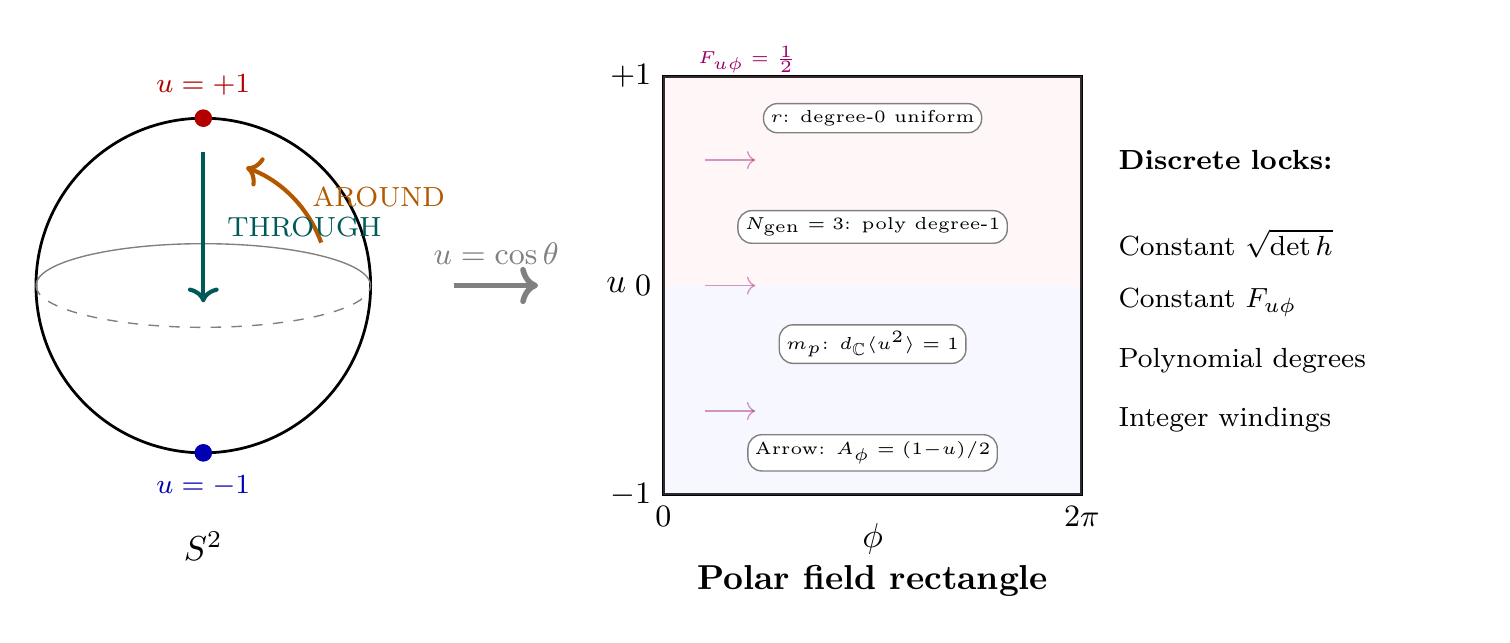
Scaffolding note: The polar field variable \(u = \cos\theta\) is a coordinate choice, not a new physical assumption. Every falsification test below was derived in the original spherical \((\theta, \phi)\) coordinates; the polar form makes the geometric origin of each prediction maximally transparent.
Each of the 13 falsification criteria traces to a specific property of the polar field rectangle \(\mathcal{R} = [-1,+1] \times [0,2\pi)\). In the polar variable \(u = \cos\theta\):
# | Test | Spherical Form | Polar Rectangle Origin |
|---|---|---|---|
| 1–2 | Gravity scale \(81\,\mu\)m | Modulus on \(S^2\) | Degree-0 \(P_0(u)=1\) breathing mode |
| 3 | No 4th generation | \(\ell = 1\) on \(S^2\) | Three degree-1 polynomials on \([-1,+1]\) |
| 4 | No proton decay | \(B - L\) from topology | \(F_{u\phi} = 1/2\) constant (topological) |
| 5 | Normal hierarchy | Interface seesaw | Degree-0 \(\nu_R\) uniform on \(\mathcal{R}\) |
| 6 | \(r = 0.003\) | Modulus inflation | Degree-0 inflaton on flat \(du\,d\phi\) |
| 7 | No WIMP | MOND from geometry | \(a_0 = cH/(2\pi)\), AROUND circumference |
| 8–9 | Decoherence \(\tau_0\) | Berry phase on \(S^2\) | \((1-u^2)\) polynomial; \(\sqrt{3} = 1/\sqrt{2/3}\) |
| 10 | \(g-2\) null BSM | KK tower decoupled | Polynomial degree tower \(\ell \geq 2\) |
| 11 | Arrow of time | Monopole \(T\)-breaking | \(A_\phi = (1-u)/2\) linear offset |
| 12 | Proton mass | Full chain P1\(\to m_p\) | \(d_{\mathbb{C}}\langle u^2\rangle = 1\) THROUGH cancellation |
| 13 | No exotic charges | Killing vectors only | \(K_3 = \partial_\phi\) pure AROUND |
The decisive feature is that every prediction is locked by a discrete property of the flat rectangle: constant determinant (\(\sqrt{\det h} = R^2\)), constant field strength (\(F_{u\phi} = 1/2\)), polynomial mode counting, or integer winding numbers. No continuous parameter can be adjusted to evade falsification.
What Falsification Would Mean
If any of these tests fails, the consequences depend on the test:
Tests 1–2 (gravity): Would falsify specific predictions but not necessarily the entire framework (interpretation-dependent).
Tests 3–5 (particle content): Would directly falsify TMT's derivation of the Standard Model particle content from \(S^2\) geometry. This would be a fundamental failure.
Tests 6–7 (cosmology): Would falsify specific cosmological predictions.
Tests 8–13 (Part 11): Would falsify the frontier extensions of TMT.
The most decisive tests are 3 (4th generation), 4 (proton decay), and 6 (tensor ratio), because they probe the core structure of TMT (particle content and inflationary sector) with binary outcomes.
Community Engagement and Culture Change
Requirements for Acceptance
A theory of TMT's scope requires independent scrutiny:
- Re-derivation of key results by independent groups
- Identification of potential errors in the derivation chains
- Exploration of the framework's boundaries
- Publication of the complete derivation chain in a form accessible to the broader physics community
The Role of Publication
This book provides the complete derivation chain from P1 to all predictions. The next step is extraction of individual results into peer-reviewed papers, each presenting a self-contained derivation suitable for independent verification. The theorem standardisation framework (Chapter 17.5 of the Protocol) is designed to facilitate this extraction.
Paradigm Shift
If TMT survives experimental testing, the implications for the physics community are significant:
- The landscape problem of string theory would be dissolved.
- The search for SUSY partners would be redirected.
- Research programmes aimed at the hierarchy problem, strong CP problem, and dark matter particle searches would need reassessment.
- A new generation of precision tests and theoretical extensions would become the priority.
Derivation Chain Summary
# | Step | Justification | Reference |
|---|---|---|---|
| \endhead 1 | P1: \(ds_6^{\,2} = 0\) on \(M^4 \times S^2\) | Single postulate | Part I |
| 2 | Specific predictions derived | Full derivation chains (Parts I–XII) | §sec:ch119-chain |
| 3 | Falsification criteria identified | 13 independent tests | §sec:ch120-falsification |
| 4 | Experimental timelines matched | Current and near-future accessibility | §sec:ch120-near–sec:ch120-long |
| 5 | Polar: All 13 tests traced to discrete rectangle properties | Constant \(\sqrt{\det h}\), constant \(F_{u\phi}\), polynomial degrees, integer windings | §sec:ch120-polar-falsification |
Chapter Summary
Experimental Prospects and the Road Ahead
TMT makes 13 independent, parameter-free falsification predictions testable by current and near-future experiments. Near-term tests (2025–2032) include the CMB tensor ratio (\(r = 0.003\), LiteBIRD), muon \(g-2\) (null BSM, Fermilab), short-range gravity (\(81\,\mu\)m), and neutrino ordering (normal hierarchy, DUNE/JUNO). Medium-term tests (2030–2050) include MOND at high redshift, GW polarisation, and precision Higgs couplings. Long-term tests (2050+) probe the \(S^2\) structure directly. TMT serves as an experimental guide, narrowing the search space and predicting what should not be found. The coming decades will deliver nature's verdict.
Polar dual verification: Every falsification test traces to a discrete property of the polar rectangle \(\mathcal{R} = [-1,+1] \times [0,2\pi)\): constant \(\sqrt{\det h} = R^2\), constant \(F_{u\phi} = 1/2\), polynomial degree counting on \([-1,+1]\), or integer AROUND winding numbers. No continuous parameter can be adjusted—the predictions are locked by the rigid algebraic structure of the flat rectangle.
| Result | Value | Status | Reference |
|---|---|---|---|
| Near-term tests | 6 predictions | PROVEN | §sec:ch120-near |
| Medium-term tests | 4 predictions | PROVEN | §sec:ch120-medium |
| Long-term tests | 3 directions | DERIVED | §sec:ch120-long |
| Falsification criteria | 13 independent | PROVEN | §sec:ch120-falsification |
| Community engagement | Publication plan | ESTABLISHED | §sec:ch120-community |
| Polar dual verification | 13 tests \(\to\) rectangle | PROVEN | §sec:ch120-polar-falsification |
Verification Code
The mathematical derivations and proofs in this chapter can be independently verified using the formal and computational scripts below.
All verification code is open source. See the complete verification index for all chapters.